
Mounting shelves, hanging artwork, or setting anchors starts with locating the framing hidden behind drywall. I’ve compared eight budget-friendly options across scanning depth, magnetic simplicity, live-wire warnings, display design, and ease of use, with extra attention to the compromises that matter once a tool leaves the box.
The Shortlist At A Glance

Kqcibz 5-In-1 Wall Multi Function Scanner, Pink

Calvana 2 Pack Magnetic Stud Finder, 27 lbs, 52300

Vaughan Magnetic Stud Finder and Level 240143

HART Professional Stud Finder with 9 Sensors

Zircon 59544 StudSensor Pro SL-AC

FOLAI 5-in-1 Smart Wall Scanner with LCD
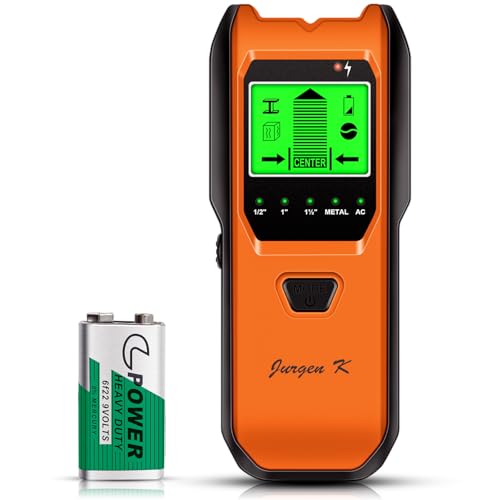
Jurgen K 5-in-1 Stud Locator, Tropical Orange

Zircon StudSensor e50 Live Wire Stud Finder
Taking A Closer Look At The Options
The Kqcibz scanner brings electronic detection into a compact pink ABS housing, covering wood, metal, and live current warnings in one package. It suits first-time DIYers handling picture hanging, shelf placement, and basic drilling around walls, floors, or ceilings.
Sensing changes in density behind the surface gives it more interpretive capability than the passive magnetic tools later in this list. The alarm adds useful hands-free feedback, although the supplied 9V battery isn’t included, making a fresh battery necessary before starting.
Where It Helps
- Five detection categories cover common framing and hidden objects.
- Audible alerts reduce the need to watch the wall continuously.
- Center and edge information supports more deliberate screw placement.
- The ABS body should prove easy to wipe clean after drywall work.
Points To Keep In Mind
- The 9V battery must be supplied separately.
- No maximum scanning depth is stated, so thick walls remain uncertain.
- Different batches may show minor color variations.
Feature Snapshot
Made For
This model fits DIYers handling routine drywall mounting with inexpensive supplies and simple wall scanning needs.
A Better Fit Elsewhere
Calvana 2 Pack Magnetic Stud Finder 52300 suits DIYers who prefer battery-free fastener detection and a two-piece setup.
Two magnetic balls make the Calvana set unusually direct: move each unit across a wall until it catches a nail or screw, then mark the attachment point. With 27 pounds of pulling force and no battery requirement, it fits quick shelf and bracket placement in standard drywall construction.
Unlike the Kqcibz scanner, this model does not electronically distinguish wood framing from metal objects or identify live wiring. In my view, that reduction in features is a fair trade for a pocketable tool that needs no calibration.
The Good Stuff
- No battery or power control simplifies each wall check.
- Strong attraction helps mark screws and nails through 5/8-inch drywall.
- Two pieces provide useful placement around crowded work areas.
- Compatibility extends to wood framing and 3/4-inch plywood.
Small Caveats
- The magnets locate steel fasteners rather than the full stud width.
- Magnet contact can leave marks on painted surfaces.
- Painted-over or missing fasteners can reduce detection consistency.
Right Fit
This set suits apartment DIYers and renters needing a fast, uncomplicated way to locate visible metal fasteners.
Another Choice May Suit
Vaughan Magnetic Stud Finder and Level 240143 offers a more compact single-tool format for marking, measuring, and locating fasteners.
The Vaughan 240143 combines a magnetic locator and compact level in a pocketable format. Its strongest use is locating steel screws or nails before marking, drilling, or checking level, particularly for compact toolbags and quick household repairs.
Magnets hold the tool against the fastener, freeing both hands for marking or drilling. Compared with Calvana’s two-ball set, Vaughan offers a more integrated workflow, though both depend on metal fasteners remaining inside the wall.
Positive Takeaways
- Pocket size suits small toolbags and mobile repairs.
- No batteries, lights, or calibration controls are needed.
- Magnetic hold supports two-handed marking and drilling.
- The level adds a useful second function.
Things To Weigh
- Wood studs without accessible nails or screws may not register.
- Fresh paint can reduce magnetic attraction.
- Exposed metal objects may create false attachment points.
Quick Facts
Travel Ready
This finder fits mobile DIYers and repair technicians who need a tiny magnetic locator without electronic controls.
Look Elsewhere When
Zircon 59544 StudSensor Pro SL-AC better serves DIYers who need deeper electronic scanning, stud-edge data, and live-wire warnings.
Nine sensors give the HART Professional a broader electronic sampling area than a basic one- or two-sensor detector. Press-and-hold operation removes calibration steps, making it approachable for routine picture hanging, TV mounting, and cabinet installation.
The moving LED display tracks the detected location as the unit travels across the surface. That visual direction helps refine placement, although none of the supplied details state a maximum depth or live-wire capability.
The Value In It
- Nine sensors provide a broader detection field.
- No calibration procedure speeds up wall checks.
- LED tracking helps narrow down the fastening location.
- Electronic scanning covers wood and metal framing.
Room For Improvement
- Scanning depth is not stated in the supplied details.
- Live AC wire detection is not specified.
- Button-controlled operation adds complexity over a magnetic finder.
- Wall dust around installation work can require careful cleaning.
Who Will Love This
This model suits beginners who want visual guidance and no calibration during common drywall installation tasks.
Reach For A Different Pick When
Zircon StudSensor e50 suits DIYers who need documented deep-scan capability and live-wire detection beyond standard framing checks.
The Zircon 59544 balances scan depth, pointing guidance, and an included torpedo level. Normal mode identifies stud edges as deep as 3/4 inch, while DeepScan mode extends to 1-1/2 inches through drywall, paneling, and most bare wood flooring.
TruCal technology adjusts to wall density, and SpotLite marks the detected target with a visible beam. That combination suits experienced DIYers handling walls, ceilings, floors, and mixed construction layers, although it carries more controls than a basic magnetic locator.
Well-Handled Touches
- Two modes support both shallow edge finding and deeper scans.
- The pointing beam helps transfer the detected location to the wall.
- Live AC voltage warning adds valuable drilling context.
- The included level supports shelf and cabinet alignment.
- Wall-density calibration supports mixed drywall conditions.
Trade Offs
- Electronic controls require more care than magnetic attraction.
- The 1-1/2-inch maximum still excludes thicker assemblies.
- Several scanning modes may slow the first wall check.
Technical Highlights
Built With In Mind
This scanner fits DIYers who routinely move between drywall, paneling, flooring, and ceiling projects.
Swap It Out When
Calvana 2 Pack Magnetic Stud Finder 52300 better serves minimalists who only need fast metal-fastener locations and battery-free operation.
The FOLAI model combines a high-definition LCD, audio alarm, and five scan modes in one electronic scanner. It is built for broad renovation checks involving framing, pipes, rebar, support beams, and live AC wiring behind walls, floors, or ceilings.
Its upgraded sensor chips seek both centers and edges, offering more placement detail than the Kqcibz model’s simpler alarm-led approach. The documented scan depth reaches 60 mm, which may suit thicker multilayer walls better, though dense assemblies can still challenge electronic readings.
Everyday Advantages
- The LCD provides clearer visual feedback than a simple alarm.
- Five modes support several hidden-material categories.
- A documented depth of 60 mm covers moderate wall buildup.
- Audio guidance assists with visual confirmation.
- Center and edge detection assists precise layouts.
Less-Strong Areas
- The display and modes add more complexity than a magnetic finder.
- Wall density and moisture may affect real-world consistency.
- Fresh drywall dust can settle around buttons and seams.
Made For
This model suits intermediate DIYers running varied renovation scans across framing, wiring, pipe, and rebar locations.
Where A Sibling Pick Shines
HART Professional Stud Finder with 9 Sensors better serves DIYers wanting simple button operation and a broader basic sensor array.
The tropical-orange Jurgen K locator brings together a smart sensor, LCD, and audio alarm for broad wall scans. Multi-sensing is intended to locate the centers and edges of framing, joists, pipes, metal, and live AC wiring, making it relevant during pictures, televisions, and renovation work.
Compared with FOLAI, the shared five-in-one concept favors the same visual-plus-auditory approach, but the supplied details do not establish a comparable depth rating. That makes Jurgen K more compelling for category coverage than for precise layered-wall work.
Everyday Wins
- LCD and alarm provide two forms of feedback.
- Five-in-one detection suits mixed renovation encounters.
- Center and edge data helps narrow mounting positions.
- The bright housing is easy to identify in a toolbag.
Potential Compromises
- Maximum scan depth is not provided.
- Electronic readings may vary across dense wall assemblies.
- The display requires a clear working angle and clean surface.
Core Details
The Right Fit
This locator fits renovation-focused DIYers who value multiple object categories and clear on-screen feedback.
Consider Something Else When
Zircon 59544 StudSensor Pro SL-AC better serves DIYers who need documented scan depths and an included leveling tool.
The Zircon StudSensor e50 narrows the gap between basic edge detection and deeper scanning. Standard mode finds wood or metal stud edges to 3/4 inch, while DeepScan doubles that reach to 1-1/2 inches, a practical distinction on thicker drywall or paneling.
An LCD shows the approach to a stud edge, and an arrow-shaped SpotLite pointer marks the wall location. Live-wire detection reaches 2 inches, adding a useful warning layer around outlets and switches, though scanning still complements rather than replaces electrical caution.
Points In Its Favor
- DeepScan doubles the standard 3/4-inch reach.
- LCD guidance clarifies edge detection.
- The arrow-shaped pointer transfers the location to the wall.
- Live-wire detection reaches 2 inches.
- The 1-1/2-inch depth suits common multilayer walls.
A Few Limitations
- It does not carry the 9-inch level included with the Zircon 59544.
- DeepScan mode may distinguish metal fasteners from full wood studs less clearly.
- Residual wall dust may require cleaning after drilling.
Feature Rundown
Whose Shelf It Belongs On
The e50 fits everyday DIYers handling drywall, plywood, shelving, artwork, and common household mounting projects.
Skip It When
Vaughan Magnetic Stud Finder and Level 240143 better serves minimalists who only need battery-free metal fastener detection and pocketable level storage.
What Matters Most Before Buying
Detection method sets the pace for daily use. Magnetic models offer the fastest response to steel nails and screws, while electronic scanners add wood, metal, pipe, and live-wire categories. I favor magnetic simplicity for quick mounting and electronic depth for walls with several material layers.
Depth matters more than sensor count in many installations. A documented 3/4-inch edge range suits standard drywall, while 1-1/2-inch DeepScan support creates extra reach through paneling and flooring combinations. Unstated depth is a meaningful gap, especially for thick renovations.
Feedback should fit the work style. Audible alarms work well when the tool is moving along a wall, while LCDs and point lights help with precise marks. Included levels add value for shelves and cabinets, but they matter more to alignment tasks than to simple fastener checks.
Common Mistakes Worth Avoiding
The biggest mistake is treating any positive reading as a complete map of the wall. A detected edge may belong to metal, wood, pipe, or another hidden object, so cross-checking remains important. Beginning with several nearby scans also reduces the chance of drilling into the wrong location.
A second trap is ignoring the wall assembly. Tile, plywood, insulation, and dense plaster can reduce sensor response or exceed stated depth. Starting with a blank section and scanning slowly helps establish how the tool reads the actual surface.
What More Money Can Add
Higher spending often brings deeper scanning, automatic wall calibration, sharper displays, integrated levels, and broader live-wire warnings. Those additions matter for renovation work where multiple concealed materials overlap or fixtures must align precisely.
For one picture or a basic bracket, the extra capability may remain unused. A strong magnetic tool can be the more rational choice for occasional mounting, while an electronic scanner earns its place in a busy renovation kit.
Frequently Asked Questions
Which type of Budget Stud Finder is simplest?
A magnetic finder requires no batteries, calibration, or display controls. It locates steel nails and screws rather than the entire width of a wood stud.
Do budget stud finders detect live wires?
Several electronic models include live-wire warnings. Zircon 59544 StudSensor Pro SL-AC and Zircon StudSensor e50 provide documented detection, while other models do not list that capability.
Is deeper scanning always better?
Deeper scanning helps with thicker drywall, paneling, and flooring combinations. It remains limited by wall density, construction layers, and the tool’s specified range.
Can a magnetic stud finder locate wood framing?
Only when accessible metal fasteners are present. Some wood studs may lack nails or screws that the magnet can reliably locate.
How should electronic stud finders be maintained?
Keep the housing dry and wipe dust from the surface and seams after drywall work. Replacing loose batteries also helps maintain consistent electronic performance.
Final Verdict
Magnetic tools win for simplicity, while electronic scanners provide broader material coverage and deeper positioning. I would choose Calvana or Vaughan for quick fastener checks, HART for easy visual guidance, and either Zircon model for deeper scans and live-wire context. The most useful choice depends on wall construction and project complexity.
