
Outdoor power setups face dampness, long cable runs, uneven campground supply, and tools that draw substantial current. I prioritize the connection type, cable length, outlet count, circuit rating, and protection features that match garages, workshops, RV hookups, gardens, and other exposed work areas. The nine options below range from compact six-foot strips to 50-foot cords and RV-specific monitoring units.
Your Options, Compared

CCCEI 12 Gauge 50FT Extension Cord, Yellow

CCCEI 12 Gauge Surge Protector, 6FT, Black
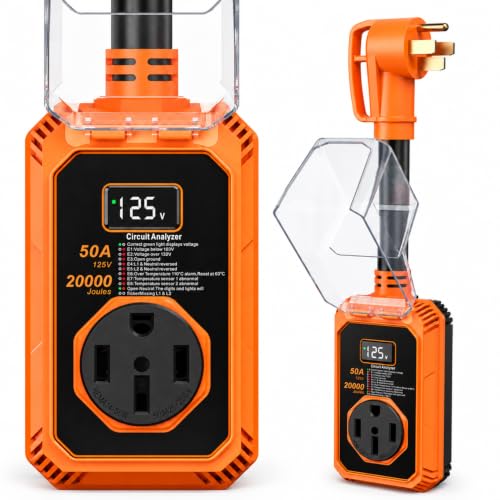
50 Amp RV Surge Protector, 20,000J Analyzer
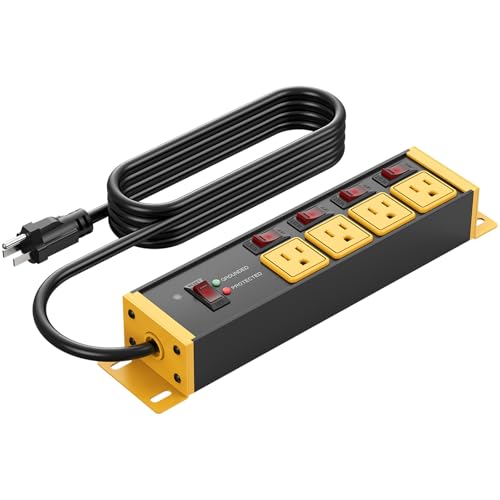
CCCEI 12 Gauge Surge Protector, 6FT, Yellow

CCCEI Magnetic 12 Gauge Surge Protector, 6FT

CCCEI 12 Gauge GFCI Power Strip, 8 Ports

CCCEI 2-Pack 12 Gauge Power Strips, 8 Ports
CCCEI 12 Gauge GFCI Power Strip, 4 Outlets

CCCEI 12 Gauge Extension Cord, 50FT, Yellow
Inside Each Recommended Option
Fifty feet solves the outlet-distance problem that ordinary indoor strips leave behind. This model suits an open garage, yard project, or distant workshop machine where extension cords are already stretching thin. The yellow jacket also makes the cable easier to spot around equipment.
Eight outlets provide useful capacity, while the 12-gauge cable and 15-amp rating suit substantial loads on a properly configured circuit. Compared with the six-foot CCCEI options later in the list, reach is the decisive advantage.
What Pays Off
- The 50-foot length reduces the need for multiple extension sections.
- Eight outlets support several tools or household devices in one location.
- The 12-gauge cable suits high-current equipment better than lighter utility cords.
- A master switch simplifies shutting down the connected group.
Things To Consider
- Its bulk makes storage less convenient than a six-foot strip.
- Long runs should remain fully uncoiled and dry during use.
Quick Facts
Who It Suits Best
Large-property owners and workshop users benefit most from the extended reach and eight-outlet layout.
Consider Something Else When
CCCEI Magnetic 12 Gauge Surge Protector, 6FT suits mobile setups that need a compact, steel-surface mounting point.
Charging ports give this six-foot strip a different role from the long-reach first option. Phones, tablets, and other USB-powered devices can draw from two USB-C ports and one USB-A port, reducing the need for separate wall adapters. That mix works well for a portable workbench, canopy, or temporary outdoor office.
Four grounded AC outlets and separate switches make cable management more precise. The 12-gauge cord carries more current than a typical lightweight office strip, although the stated 15-amp capacity still requires a matching circuit.
Everyday Perks
- Two USB-C ports support modern charging cables.
- One USB-A port serves older wired charging setups.
- Individual outlet switches avoid shutting down unrelated devices.
- The master switch provides one central control point.
- Overload and grounding protection add useful safeguards.
Worth Noting
- The USB output ratings are not provided, so cable and device compatibility deserves checking.
- Weather exposure still calls for covered placement.
Feature Snapshot
Built With In Mind
Mobile workers, students, and campers benefit from the mix of AC and USB connections.
Another Choice May Suit
50 Amp RV Surge Protector, 20,000J Analyzer better serves RV users who need live supply monitoring and automatic disconnection.
RV hookups demand more than basic surge diversion. This model monitors campground voltage, provides a 20,000-joule surge-protection rating, and disconnects power automatically when conditions warrant. That combination makes it more relevant to an RV than a conventional tool-oriented strip.
A circuit analyzer, meaning a diagnostic device that checks the supplied electrical condition, gives campers a clearer view before energizing the vehicle. The real-time display is useful during arrival, although readings should be interpreted alongside the RV maker’s instructions.
Useful Highlights
- 20,000-joule capacity targets substantial surge absorption.
- Real-time voltage display helps identify changing pedestal conditions.
- Automatic power disconnect reduces exposure to unsafe supply conditions.
- Circuit analysis adds context beyond basic surge blocking.
- Overheat protection addresses another RV electrical concern.
Honest Caveats
- The 50-amp configuration is specialized and must match the RV connection.
- Its campground focus makes it bulky for ordinary patio equipment.
Key Product Details
Right Fit For
RV campers using 50-amp campground service benefit most from the monitoring and cutoff functions.
Look Elsewhere When
CCCEI 12 Gauge 50FT Extension Cord, Yellow is the more practical fit for ordinary tools positioned far from an outlet.
A six-foot workshop strip keeps frequently used tools close to the outlet without a large cable loop. This CCCEI model provides four outlets, individual controls, and a wall-mountable body. The yellow cable and enclosure remain easy to locate in a busy garage.
Its 5-15P wall plug and mixed 5-20R and 6-20R receptacles offer flexibility for standard three-prong equipment. Each receptacle has its own breaker, which lets a problem on one connection be isolated without shutting down every attached device.
Positive Takeaways
- Four separately switched outlets support organized tool groups.
- Wall mounting keeps the strip off floors and work surfaces.
- Individual breakers isolate connections more precisely.
- The 6-foot length is easier to coil and store.
Minor Gripes
- Four outlets may be limited for a multi-person workshop.
- Wall placement needs secure hardware and a suitable surface.
- Dust and moisture still require occasional care.
Made For
Garage users and weekend project organizers benefit from independent outlet control and compact mounting.
Reach For A Different Pick When
CCCEI 2-Pack 12 Gauge Power Strips, 8 Ports suits workshops needing two separate eight-outlet stations.
The magnetic back changes where a portable strip can live. Mounted to a steel cabinet, vehicle panel, or metal workbench, the strip can remain visible without occupying a floor area. That makes it especially useful for mobile repair work where loose strips are easily kicked or snagged.
Four outlets and a master switch cover basic temporary power needs, while individual 20-amp controls add operating flexibility. The 12-gauge, six-foot cord carries a stated 15-amp load rating, and the orange housing stands apart from gray or yellow alternatives.
Practical Advantages
- Magnetic attachment keeps the strip positioned on steel surfaces.
- Four outlets reduce the need for several compact adapters.
- Individual breakers permit targeted power control.
- A master switch provides a common shutdown control.
Points To Note
- Magnet attachment does not suit wood, plastic, or aluminum surfaces.
- Heavy vibration may require occasional repositioning.
- Surface condition should be checked before mounting.
Who Will Love This
Mobile technicians and metalworkers benefit from an outlet strip that can attach directly to equipment.
Not Your Match When
CCCEI 12 Gauge GFCI Power Strip, 8 Ports offers a better fit for nonmagnetic surfaces and larger equipment groups.
GFCI protection is the defining feature here. A ground-fault circuit interrupter monitors current imbalance and interrupts power during a ground-fault condition, making this arrangement more relevant around damp exterior work areas than a basic strip. Eight outlets also serve a broad collection of low- and medium-draw devices.
The six-foot 12-gauge cord is rated for 15 amps, 125 volts, and 1,875 watts. Compared with the four-outlet option later in the list, it trades individual outlet control for a central 20-amp switch and greater connection capacity.
Good Reasons To Consider
- GFCI protection adds ground-fault monitoring.
- Eight outlets simplify multi-device setups.
- The 12-gauge cord handles heavier loads than a thin utility strip.
- Overload and grounding safeguards round out the protection functions.
- Gray housing blends more discreetly into some workspaces.
Practical Considerations
- The GFCI function should be checked through normal operation.
- A central switch lacks the finer control of individual buttons.
- Outdoor placement still benefits from a weather cover.
Core Details
Best Suited To
Damp patio, garden, and exterior workshop setups benefit from the GFCI function.
A Better Fit Elsewhere
50 Amp RV Surge Protector, 20,000J Analyzer serves RV campers who need pedestal voltage analysis and automatic cutoff.
Two strips make it easier to organize separate parts of a garage, workshop, or event area. Each unit supplies eight outlets, creating 16 connections in total. That scale suits shared work surfaces where a single central strip would produce a thick cluster of cables.
The strips use 12-gauge, six-foot cords and include 5-20R and 6-20R receptacles with a standard three-prong plug. Their stated 20-amp rating requires careful load distribution, particularly where several high-draw devices share one circuit.
What Stands Out
- The two-pack supports separate work zones.
- Eight outlets per strip reduce extension complexity.
- Mixed receptacle formats broaden equipment compatibility.
- Wall mounting helps keep connections off the floor.
- Six-foot cords simplify handling and storage.
Trade Offs
- Two full-size strips require two suitable wall outlets.
- The stated capacity must be spread across appropriate circuits.
- Mounting hardware and surface preparation add setup work.
Whose Shelf It Belongs On
Workshop organizers and hobbyists benefit from two independent eight-outlet stations.
Swap It Out When
CCCEI Magnetic 12 Gauge Surge Protector, 6FT fits mobile work where mounting to a steel surface is more useful.
Individual switching makes this four-outlet strip convenient for shared spaces. A phone charger can remain connected while a shop vacuum, radio, or work light is shut down separately. That control is useful around outdoor kitchens, patios, and temporary project stations where several devices serve different routines.
GFCI protection adds ground-fault interruption, while overload and grounding protection cover other basic electrical safeguards. The six-foot, 12-gauge cord carries a stated 15-amp rating. It is less roomy than the eight-port GFCI option, but the layout is easier to manage.
Real Benefits
- Individual switches allow targeted device control.
- GFCI protection suits damp working environments.
- Four outlets keep connections moderate and organized.
- The 12-gauge cord supports heavier loads than standard utility cords.
Small Caveats
- Four outlets may not cover a busy workshop.
- Individual switches do not provide the GFCI controls of a receptacle with visible status indicators.
Feature Breakdown
Who Should Grab It
Outdoor cooks and compact workshop users benefit from GFCI protection and individual device control.
Where A Sibling Pick Shines
CCCEI 12 Gauge 50FT Extension Cord, Yellow suits projects where outlet distance matters more than USB charging or GFCI control.
Fifty feet of reach and four individually switched outlets make this cord more versatile than a basic single-socket extension. It suits a garden, detached shop, outdoor event area, or property where equipment sits well beyond the nearest wall outlet. The yellow jacket also improves visibility around work zones.
Its 12-gauge construction and stated 15-amp, 125-volt rating accommodate higher-current equipment on a suitable circuit. Individual switches reduce the need to disconnect everything, while the dedicated circuit breaker provides a central protection point.
Strengths Worth Knowing
- Fifty-foot reach serves distant outdoor equipment.
- Four switched outlets provide flexible device control.
- The 12-gauge cable supports heavier-duty connections.
- Yellow coloring improves cable visibility.
- The central breaker simplifies resumption after a cutoff.
Details To Watch
- The long cable is less convenient to store.
- It should be protected from standing water and fully uncoiled under load.
- Four outlets are fewer than the eight offered by the first option.
The Right Fit
Property owners and outdoor hobbyists benefit from extended reach with individual outlet control.
Skip It When
CCCEI 12 Gauge Surge Protector, 6FT, Black is a closer match for a six-foot mobile station that also needs USB charging.
Matching Electrical Needs With Outdoor Conditions
Start With Connection Type
A standard three-prong connection fits common household outlets, while 50-amp service belongs to many RVs. I verify the receptacle shape, amperage, and voltage before purchasing any extension arrangement. A matching plug is necessary, but load distribution and circuit capacity still determine whether the setup is suitable.
Match Cable Length to the Task
A six-foot strip works well around a bench or patio table. Reaching across a lawn, driveway, or detached workshop favors a 50-foot cord, though greater length adds weight and cable-management demands. I favor the shortest length that removes the need for risky cable chains or several linked extensions.
Understand the Protection Layers
Surge protection diverts transient electrical spikes, GFCI protection responds to ground-fault conditions, and an overload breaker limits excessive current. These functions address different problems and should not be treated as interchangeable. Outdoor equipment near water may benefit from GFCI protection, while RV hookups may need voltage analysis and automatic disconnection.
Count Outlets and Controls
Eight receptacles suit crowded work areas, while four allow simpler organization. Individual switches save time by isolating one device without disrupting the others. Wall mounting can reduce snagging in garages, while a magnetic back suits mobile work on steel equipment.
Practical Details Before Deployment
Mistakes Worth Dodging
I avoid treating a long cable as unlimited current capacity. The gauge, length, connectors, and supply circuit all matter, and linked strips can create avoidable heat. I also keep connections dry, inspect cables for damage, and use appropriate covers rather than assuming a heavy-duty jacket makes a strip weatherproof.
The Upgrade Payoff
Additional spending may bring more receptacles, GFCI controls, voltage monitoring, or automatic disconnection. Those features help when the environment includes moisture, variable campground power, or frequent device changes. A basic six-foot strip remains sensible for a dry, compact task with a manageable number of connected items.
Frequently Asked Questions
Are outdoor power strips safe for damp locations?
A heavy-duty cord is not automatically weatherproof. I favor GFCI protection, covered connections, elevated placement, and regular inspection for moisture or physical damage.
Is a 12-gauge extension cord suitable for power tools?
A 12-gauge cable can support many high-current tools when the circuit and total load are appropriate. Individual high-draw equipment still requires careful load management.
Do all surge protectors provide GFCI protection?
No. Surge diversion and ground-fault interruption perform different functions. I check the labeling to confirm which safeguards the model includes.
Which length works for a detached workshop?
A 50-foot cord suits many detached buildings, but the route, wall rating, and available circuit must be checked first. Shorter runs reduce clutter and simplify storage.
Are RV campground voltage monitors necessary?
They add useful visibility into changing pedestal conditions. I consider them alongside a compatible 50-amp connection, automatic cutoff, and the RV maker’s guidance.
Final Verdict
I favor the 50-foot CCCEI cords for distant equipment, the magnetic strip for mobile metalwork, and the GFCI models for damp exterior projects. The TGJOR RV analyzer occupies its own niche through voltage monitoring and automatic disconnection. The right choice comes down to connector type, required reach, outlet control, and the electrical environment.
