
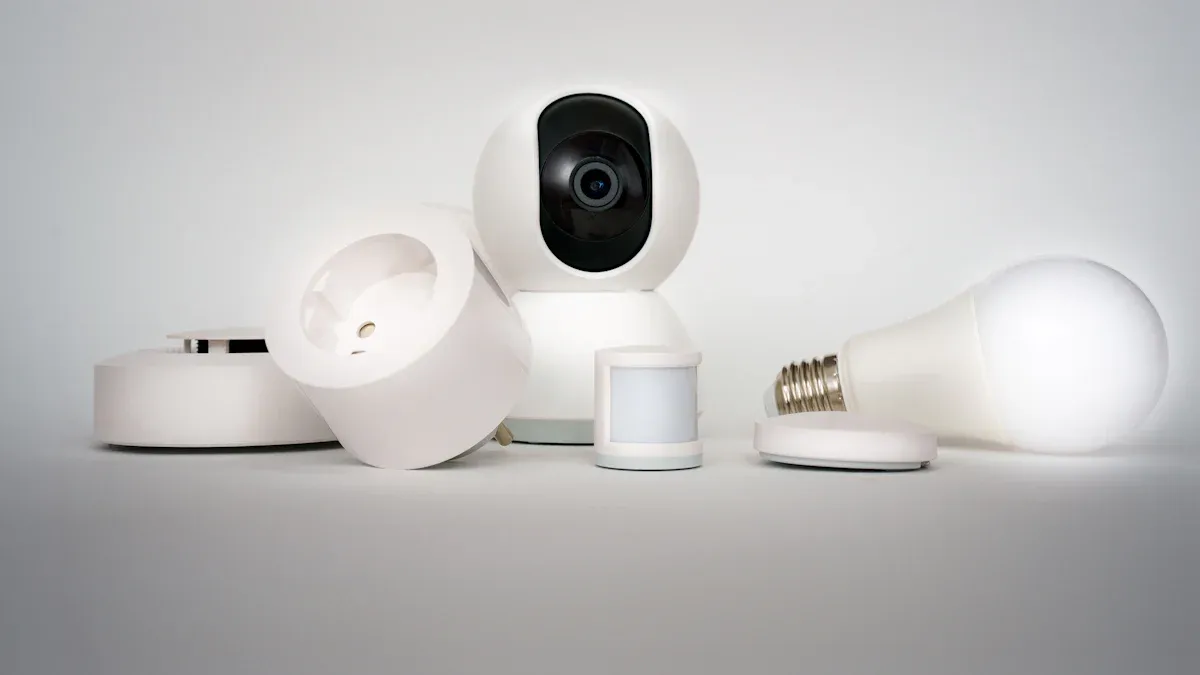
Imagine walking into your home and simply saying, “Turn on the lights,” or “Play my favorite playlist.” Voice-controlled technology has surged in popularity, making this a reality for many. Today, AI assistants have become essential in our daily living, helping you manage tasks effortlessly. Studies show that 72% of voice-activated speaker owners use their devices daily. With 40% of U.S. households already embracing smart home devices, you might wonder how these technologies enhance your convenience and overall quality of life.
Key Takeaways
Voice-controlled technology simplifies daily tasks, allowing you to manage your home with simple commands.
AI assistants learn from your habits, providing personalized responses that enhance your experience.
Smart home devices work together seamlessly, making it easy to control various appliances from one interface.
AI assistants improve home security by integrating with smart devices, offering real-time alerts and remote monitoring.
Embracing smart home technology can lead to energy savings and a more comfortable living environment.
Rise of AI Assistants

Current Trends
AI assistants have come a long way since their inception. In the early days, voice recognition systems like IBM’s Shoebox in 1961 could only recognize spoken digits. Fast forward to today, and you can control your entire home with just your voice. Here are some current trends shaping the world of smart home assistants:
Rising Demand for Convenience and Automation: You likely want to simplify your daily tasks. Voice-controlled devices make this possible, allowing you to manage everything from lighting to music with ease.
Evolution of Natural Language Processing (NLP): Thanks to advancements in NLP, your smart home assistants can understand a wider range of commands. This means you can interact with them more naturally, making your experience smoother.
Increasing Adoption of IoT and Connectivity: The Internet of Things (IoT) connects various devices in your home. This integration allows for seamless control, enhancing your overall smart home experience.
User Engagement
User engagement with AI assistants has significantly changed over the past five years. The introduction of devices like Amazon Alexa and Google Assistant has made smart homes more intuitive. You can now interact with your home in ways that were once unimaginable.
Evidence | Description |
|---|---|
Voice Control Technologies | These assistants have transformed how you manage tasks, making everything hands-free and more accessible. |
Personalization | AI-driven devices learn from your habits, providing tailored responses that enhance your satisfaction. |
IoT Integration | The growth of IoT technologies allows you to manage interconnected devices effortlessly, increasing your interaction with them. |
As you can see, the evolution of AI in smart home tech has led to a more engaging and user-friendly experience. With each advancement, these virtual assistants become more capable of handling your daily needs.
Smart Home Integration
Device Compatibility
One of the most exciting aspects of smart home technology is how well different devices work together. You can control various smart appliances from different manufacturers through a single interface, thanks to AI assistants. This interoperability makes your life easier and enhances your overall smart home experience.
Here’s a quick look at how AI assistants facilitate this integration:
Evidence | Description |
|---|---|
Integration | AI assistants allow users to control various devices from different manufacturers through a single interface, enhancing the smart home experience. |
Voice Control | AI assistants can recognize commands and understand context, enabling control over a wide range of smart devices. |
Seamless Integration | AI devices work together to create a unified smart home ecosystem, facilitating interoperability. |
Imagine walking into your home and saying, “Turn on the living room lights and set the thermostat to 72 degrees.” With compatible devices, your AI assistant can handle it all in one go. This level of convenience is what makes smart home automation so appealing.
Enhanced User Experience
The user experience in smart homes has improved dramatically, thanks to advancements in technology. You want your interactions with smart home assistants to feel natural and intuitive. Here are some key features that contribute to an enhanced user experience:
Capability | Description |
|---|---|
Natural Language Processing | Enables understanding of conversational commands for intuitive interactions. |
Voice Recognition | Recognizes accents and speech patterns, enhancing global accessibility. |
Integration with Smart Home Devices | Connects to devices like lights and thermostats for convenience. |
Personalization | Adapts to user preferences by learning from behavior. |
Task Automation | Handles tasks like scheduling, improving efficiency. |
With these features, your AI assistant becomes more than just a tool; it transforms into a helpful companion that understands your needs. You can ask it to play music, set reminders, or even control your home security system-all with simple voice commands. This seamless interaction makes your connected living spaces feel more like home.
Popular Use Cases
Everyday Tasks
AI assistants have become your go-to helpers for managing everyday tasks. With just your voice, you can control various aspects of your home. Here are some common tasks that smart home assistants handle:
Control lighting, heating, and home security.
Adjust lighting based on your mood or needs.
Monitor food freshness and suggest recipes.
Place grocery orders automatically.
These voice-activated assistants understand the context of your commands. For example, when you say, “Turn up the heat,” they know you’re referring to the thermostat. They also remember past interactions, which helps them improve their responses over time. This means you get personalized assistance tailored to your preferences.
Home Security
Home security is another area where AI assistants shine. They integrate seamlessly with smart devices to provide you with enhanced protection. Here’s how they improve your home security:
AI-powered security systems offer accurate and reliable protection.
They analyze patterns and recognize familiar faces, reducing false alarms.
These systems detect unusual motion or behavior in real time and send alerts only for suspicious activity.
Smart lights, alarms, and voice assistants work together to create a secure environment. For instance, if a security camera detects movement, it can trigger a smart switch to turn on a lamp, making it look like someone is home.
You can also monitor your home remotely. AI assistants provide real-time alerts, allowing you to access live video feeds and communicate through mobile apps from anywhere. This level of control enhances your peace of mind, knowing that your home is secure even when you’re away.
With AI assistants managing everyday tasks and bolstering your home security, you can enjoy a more convenient and safe living environment.
Benefits of Smart Homes
Convenience for All Ages
Smart homes offer incredible convenience for everyone, from children to seniors. Imagine a home where you can control everything with just your voice. This technology makes life easier for all age groups. Here’s how:
Age Group | Convenience Feature | Description |
|---|---|---|
Children | Voice Control | Kids can easily access music or set timers using simple voice commands. |
Adults | Shared Calendar | Family members can add items to a shared shopping list by speaking, enhancing coordination. |
Elderly | Simplified Access | Older adults can control devices and get information without needing to navigate complex interfaces. |
AI assistants serve as a central communication hub in households. They help reduce the overhead of coordination, allowing family members to communicate effectively, regardless of age. This feature is particularly beneficial for families with children and elderly members, simplifying the process of managing household tasks and schedules.
Energy Optimization
AI-driven smart homes excel at optimizing energy usage, which can lead to significant savings on your utility bills. Here’s how these systems work to keep your home efficient:
Smart Thermostats: These devices learn your schedule and adjust heating and cooling accordingly. This means they can lower energy use when you’re not home and ensure comfort when you are.
Automated Lighting: Smart lighting systems can turn off lights in unoccupied rooms, reducing unnecessary energy consumption.
Energy Management Systems: These systems analyze your energy usage patterns and suggest ways to save. Studies show that implementing Home Energy Management Systems (HEMS) can reduce electricity bills by about 35%.
Evidence Description | Details |
|---|---|
Energy Savings Potential | A proper implementation of Home Energy Management Systems (HEMS) can reduce electricity bills by about 35%. |
Integration of Technologies | HEMS combines AI, IoT, and voice assistants to analyze data and optimize energy usage. |
Practical Implementation | The system has been tested in real pilot projects, demonstrating its effectiveness in optimizing energy decisions. |
By using AI assistants for home automation, you can enjoy a more comfortable living environment while also being mindful of your energy consumption. This not only helps your wallet but also contributes to a more sustainable future.
Challenges and Privacy
Data Security
As you embrace the convenience of AI assistants in your home, it’s essential to consider data security. These devices generate vast amounts of personal data, which can be vulnerable to unauthorized access or misuse. Here are some primary concerns:
AI assistants can be targets for hackers, leading to potential data breaches.
Attackers might exploit APIs to access sensitive information.
Compromised assistants could request personal details under false pretenses, highlighting the need for robust security protocols.
To address these concerns, leading AI assistant providers have implemented various measures. For instance, Anthropic Claude does not use user inputs for training unless you opt in. OpenAI’s ChatGPT provides a comprehensive overview of data collection but lacks detailed user rights information. Google Gemini collects user data but allows you to manage privacy settings, including options to limit data retention.
User Trust
User trust plays a crucial role in how you interact with virtual assistants. If you don’t trust these devices, you may hesitate to use them fully. Recent studies show that 58% of people trust AI-enabled machines. Google Assistant stands out as the most trusted virtual assistant, with 89% of users expressing confidence in it.
Factor | Finding | Percentage |
|---|---|---|
Trust in AI-enabled machines | 58% of respondents reported trusting AI-enabled machines. | 58% |
Most trusted assistant | Google Assistant was reported as the most trusted virtual assistant. | 89% |
Most widely used assistant | Google Assistant was also the most widely used among respondents. | 56% |
Perceived trust significantly impacts your willingness to use these technologies. When you trust your AI assistant, you feel more confident in its performance and ease of use. However, concerns about payment security, privacy, and loss of control can hinder your trust. Approximately 33% of users worry about payment security, which can affect their overall experience.
By addressing these challenges and fostering trust, AI assistants can become even more integral to your daily life, enhancing your home experience while keeping your data secure.
AI assistants have truly transformed your daily living. They reduce human error and enhance productivity, making life easier. With features like precise climate control and automated responses, these virtual assistants create a seamless home environment. As technology evolves, expect even smarter systems that adapt to your needs. By 2026, voice-controlled technology will offer personalized experiences, simplifying your interactions at home.
Consider how you can integrate these advancements into your life. Whether it’s controlling your lights or enhancing security, the possibilities are endless. Embrace the future of smart living!
FAQ
What are virtual assistants?
Virtual assistants are AI-powered tools that help you manage tasks using voice commands. They can control smart devices, play music, set reminders, and answer questions, making your daily life easier.
How do I set up a virtual assistant?
To set up a virtual assistant, connect it to your Wi-Fi network and download the corresponding app on your smartphone. Follow the on-screen instructions to link your smart devices and customize settings.
Can virtual assistants improve home security?
Yes! Virtual assistants can integrate with security cameras, alarms, and smart locks. They provide real-time alerts and allow you to monitor your home remotely, enhancing your overall security.
Are virtual assistants safe to use?
While virtual assistants offer convenience, they can pose privacy risks. Ensure you use strong passwords, regularly update your devices, and review privacy settings to protect your data.
Can I use multiple virtual assistants in my home?
Absolutely! You can use multiple virtual assistants in your home. Just ensure they are compatible with your smart devices and set them up to work together for a seamless experience.