

Choosing the right television is crucial for your viewing experience. Different technologies like OLED, QLED, and LED each have unique features that can influence your satisfaction. For instance, OLED offers superior contrast and color accuracy, enhancing your overall experience. QLED shines with higher brightness and affordability, making it a popular choice among budget-conscious consumers. Meanwhile, LED provides basic performance, which may not meet the needs of those seeking high-end viewing. Understanding these differences helps you choose the right television and make an informed choice when you buy a new TV.
Key Takeaways
OLED TVs provide stunning picture quality with deep blacks and wide viewing angles, making them perfect for movie lovers.
QLED TVs excel in brightness and color accuracy, making them ideal for bright rooms and daytime viewing.
LED TVs are budget-friendly and versatile, but they may lack the contrast and color depth of OLED and QLED options.
Consider your viewing habits and room lighting when choosing a TV to ensure the best viewing experience.
For gaming, OLED offers fast response times, while QLED and LED are better for bright environments.
OLED Technology
Advantages of OLED
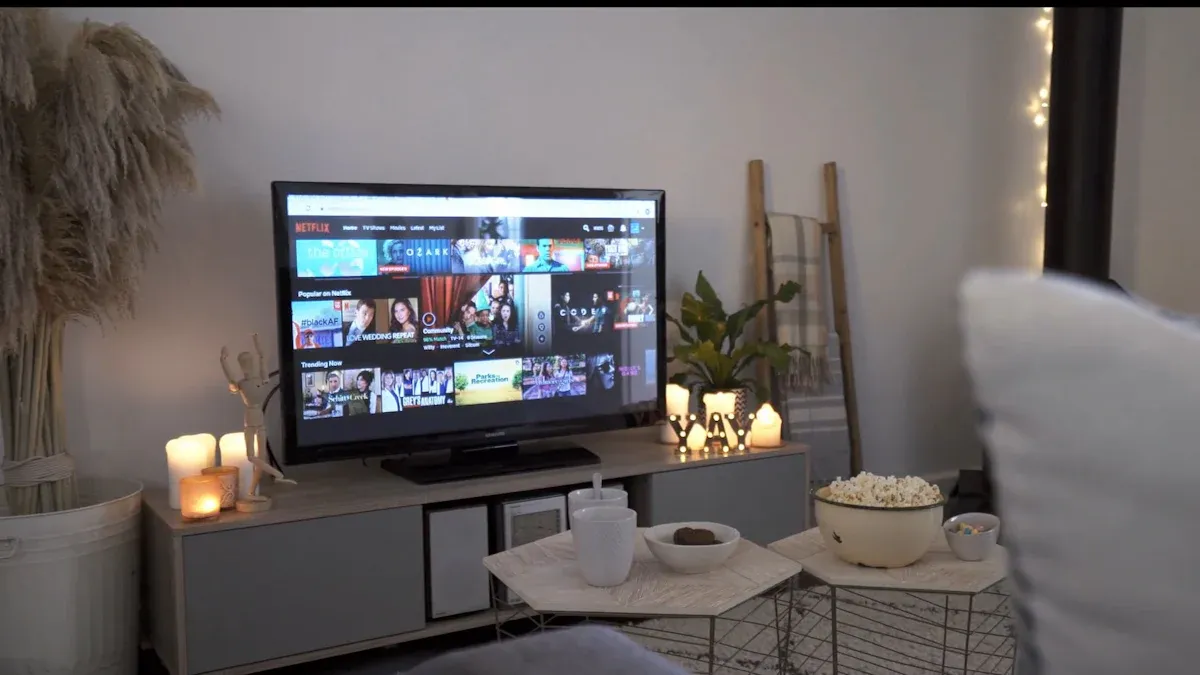
OLED technology stands out due to its self-emitting pixels. Unlike traditional LCDs, OLED displays do not require backlighting. This feature allows for true black levels, as individual pixels can turn off completely. Here are some key advantages of OLED:
High Contrast: OLED screens achieve incredibly high contrast ratios, theoretically approaching infinity. This means you see deeper blacks and brighter whites, enhancing your viewing experience.
Color Accuracy: OLED displays provide vibrant colors and maintain their accuracy even at various viewing angles. You can enjoy consistent picture quality whether you sit directly in front or off to the side.
Viewing Angles: With OLED, you experience minimal changes in color and brightness when viewing from different angles. This is a significant advantage over LCDs, which often suffer from color shifts and loss of saturation when viewed from the side.
Disadvantages of OLED
Despite their impressive features, OLED screens come with some drawbacks. Here are the most commonly reported disadvantages:
Disadvantage | Description |
|---|---|
Subpar text clarity | OLED panels have a different subpixel layout compared to traditional LCDs, leading to inferior text quality. |
High maintenance | Users need to be cautious about screen burn-in and image retention, requiring careful management of display settings and wallpaper choices. |
Brightness limitations | OLED televisions may not achieve the same brightness levels as some LCDs, which can affect viewing in well-lit environments. |
Potential for burn-in | Prolonged display of static images can lead to permanent burn-in on OLED screens, necessitating user vigilance to avoid this issue. |
QLED Technology
Advantages of QLED
QLED technology uses quantum-dot technology to enhance your viewing experience. This method converts blue LED light into pure red and green light. As a result, QLED TVs offer several advantages:
Superior Brightness: QLED TVs maintain excellent brightness levels, making them ideal for well-lit rooms. You can enjoy your favorite shows during the day without straining your eyes.
Vivid Colors: With a broader and more accurate color gamut, QLEDs deliver more saturated colors compared to traditional LCDs. This feature enhances your viewing experience, especially for HDR content.
Longevity: QLED TVs are durable and do not suffer from screen burn-in. This makes them a smart long-term investment for your home entertainment system.
Wide Viewing Angles: You can enjoy consistent color and brightness from various angles, making QLEDs perfect for family gatherings or movie nights.
Here’s a quick comparison of QLED technology against traditional LCDs:
Feature | QLED Technology | Traditional LCD |
|---|---|---|
Color Reproduction | More saturated colors | Limited color accuracy |
Brightness | Higher peak brightness | Dependent on white LED backlighting |
Color Gamut | Broader and more accurate | Restricted by color filters |
Longevity | Better longevity | Varies by model |
Disadvantages of QLED
While QLED TVs have many strengths, they also come with some drawbacks:
Disadvantage | Description |
|---|---|
Black Levels & Contrast Limitations | QLEDs cannot achieve the same perfect blacks as OLEDs due to limitations in local dimming. |
Viewing Angle Fall-Off | Color and brightness degrade when viewed from the side. |
Greater Bulk | QLEDs are thicker due to backlighting and dimming zones, making them harder to integrate into slim spaces. |
LED Technology
Advantages of LED
LED technology has become a popular choice for many viewers. It uses backlighting methods that significantly impact picture quality. Here are some advantages of LED TVs:
Better Contrast: Full-array backlighting with local dimming creates deeper blacks and brighter whites. This feature enhances your viewing experience, especially in darker scenes.
Enhanced Colors: LED backlighting ensures vibrant and accurate color reproduction. According to a study by DisplayMate Technologies, TVs with advanced backlighting achieve up to 30% better color accuracy compared to older models.
Uniform Brightness: Direct-lit and full-array setups reduce uneven brightness across the screen. This uniformity allows for a more enjoyable viewing experience.
Disadvantages of LED
While LED TVs offer many benefits, they also have some drawbacks. Here are the most common disadvantages reported by users:
Disadvantage | Description |
|---|---|
Limited Viewing Angles | LED screens can lose brightness and color accuracy when viewed from the side rather than head-on. |
Heat Generation | LED screens generate heat during operation, which may require additional cooling systems. |
Environmental Impact | Improper disposal of LED screens can contribute to e-waste and light pollution. |
Calibration Required | Regular calibration is needed to maintain color accuracy, which can be time-consuming and costly. |
When comparing Edge Lit and Full-Array LED TVs, you will notice distinct differences in performance. Here’s a quick comparison:
Feature | Edge Lit TVs | Full-Array TVs |
|---|---|---|
Backlighting | LEDs placed on the rim, requiring a diffuser | LEDs divided into multiple zones for control |
Contrast Ratio | Lower precision in local dimming | Better contrast with dynamic backlight control |
Picture Quality | Generally less capable of deep blacks and bright highlights | Excellent for HDR with deep blacks and bright highlights |
LED technology provides a solid option for many viewers, especially those who prioritize brightness and color accuracy.
Key Features Comparison: LED vs OLED vs QLED
Brightness
When it comes to brightness, each technology has its strengths.
LED TVs excel in bright environments. They can achieve high peak brightness levels, making them suitable for daytime viewing.
QLED TVs also shine brightly, often outperforming OLEDs in well-lit rooms. Their quantum-dot technology enhances brightness without sacrificing color.
OLED TVs, while capable of impressive brightness, may struggle in very bright settings. They provide excellent contrast in darker scenes but can appear dimmer in bright light.
Color Accuracy
Color accuracy is crucial for an immersive viewing experience.
OLED TVs deliver stunning color accuracy. Each pixel emits its light, allowing for vibrant colors and deep blacks. This feature enhances the overall picture quality.
QLED TVs offer a broader color gamut, producing vivid colors that pop. They maintain color accuracy even at high brightness levels, making them ideal for HDR content.
LED TVs can vary in color accuracy. While many models perform well, they often cannot match the precision of OLED or QLED displays.
Price Points
Price is a significant factor when choosing a TV.
LED TVs generally offer the most budget-friendly options. You can find a wide range of models at various price points, making them accessible for many consumers.
QLED TVs fall in the mid-range to high-end category. They provide excellent performance and features, justifying their higher price compared to LED models.
OLED TVs typically command the highest prices. Their advanced technology and superior picture quality come at a premium, but many consider it worth the investment.
Uniformity and Viewing Angles
Uniformity and viewing angles can significantly impact your viewing experience. The following table summarizes how these features differ among the three technologies:
Technology | Uniformity | Viewing Angles |
|---|---|---|
OLED | Better | Wider |
QLED | Moderate | Limited (improves in high-end models) |
LED | Varies | Limited |
Energy Consumption
Energy efficiency is another important consideration. Here’s how the technologies compare:
OLED TVs are the most energy-efficient, using 20–30% less power than equivalent LED or QLED TVs.
QLED TVs consume more electricity than OLEDs due to constant backlighting and higher peak brightness.
OLED panels light up each pixel individually, which reduces power usage during dark scenes.
Repair and Maintenance Costs
Understanding repair and maintenance costs can help you make a more informed decision. The following table outlines average lifespans and repair costs for each type of TV:
TV Type | Average Lifespan | Repair Cost for Cracked Screen | Repair Cost for Power Supply Failure | Repair Cost for Main Board Replacement |
|---|---|---|---|---|
LED | 4–10 years | $300–$600+ | $30–$100 | $50–$150+ |
OLED | 5–8 years | $300–$600+ | $30–$100 | $50–$150+ |
QLED | 7–10 years | $300–$600+ | $30–$100 | $50–$150+ |
Cracked screens typically cost between $300 and $600+ to repair, which is often not worth it.
Power supply failures can be repaired for $30 to $100 in parts.
Main board replacements range from $50 to $150+.
How to Choose the Right Television for You
Choosing the right television depends on your viewing habits and the environment where you plan to use it. Here’s a breakdown of which technology works best for different scenarios.
Best for Movies
If you love watching movies, consider an OLED TV. The LG C5, for example, is highly praised for its outstanding contrast ratio and image quality. This model features a Filmmaker Mode that displays films as intended by the director. This mode enhances your viewing experience, especially in dark environments. The self-emitting pixels of OLED technology provide true blacks and vibrant colors, making every scene come alive.
For movie enthusiasts, the immersive experience that OLED offers is hard to beat. You’ll enjoy deep blacks and rich colors that enhance the storytelling.
Best for Gaming
When it comes to gaming, you want a TV that can keep up with fast-paced action. Here’s a comparison of how different technologies stack up for gaming:
Feature | LED | QLED | OLED |
|---|---|---|---|
Backlight | Yes | Yes | No (self-illuminating) |
Color Range | Limited | Wider due to Quantum Dots | Excellent (pure blacks) |
Brightness | Moderate | High | Moderate |
Ideal for Bright Rooms | Yes | Yes | No |
Response Time | Moderate | Moderate | Fast |
OLED TVs excel in response time, making them ideal for gaming. You’ll experience minimal lag, which is crucial for competitive gaming. However, if you play in a bright room, QLED or LED might be better choices due to their higher brightness levels.
Best for Bright Rooms
If your viewing area is well-lit, you need a TV that can handle bright conditions. Here’s how the technologies perform in bright rooms:
Technology | Peak Brightness Performance | Suitability for Bright Rooms |
|---|---|---|
OLED | Limited at high APL | Less suitable |
LCD | Excellent | More suitable |
LED and QLED TVs shine in bright environments. They can achieve high peak brightness, making them suitable for daytime viewing without losing picture quality. If you often watch TV during the day, these technologies will help you avoid glare and reflections.
When choosing the right television, consider the placement of the TV in relation to light sources. Avoiding screen glare is crucial for an enjoyable viewing experience. Additionally, think about the general lighting of the room. Bright environments favor LED and QLED, while darker settings are better suited for OLED.
Choosing the right television depends on your viewing habits and preferences. OLED offers stunning picture quality with deep blacks and wide viewing angles, making it ideal for movie lovers. QLED provides excellent brightness and color accuracy, perfect for bright rooms. LED TVs are budget-friendly and versatile but may lack the contrast of OLED and QLED. Consider your needs carefully. For example, if you often watch with family, OLED’s superior viewing angles can enhance group experiences. Ultimately, select a screen that fits your lifestyle and enhances your enjoyment.
FAQ
What is the difference between OLED and QLED screens?
OLED screens use self-emitting pixels for better contrast and color accuracy. QLED screens utilize quantum dots for enhanced brightness and color saturation. Choose OLED for dark environments and QLED for bright rooms.
How long do LED TVs typically last?
LED TVs generally last between 4 to 10 years, depending on usage and model quality. Regular maintenance can help extend their lifespan, ensuring you enjoy your screen for years to come.
Can I use an OLED TV in a bright room?
While you can use an OLED TV in a bright room, it may not perform as well as QLED or LED screens. The brightness levels of OLEDs are lower, which can affect visibility in well-lit spaces.
Are QLED TVs prone to burn-in?
No, QLED TVs are not prone to burn-in like OLED screens. Their technology prevents static images from causing permanent damage, making them a safer choice for varied content viewing.
What should I consider when buying a TV?
Consider your viewing habits, room lighting, and budget. OLED offers superior picture quality, QLED excels in brightness, and LED provides budget-friendly options. Choose based on your specific needs.