
A laser plumb bob transfers a vertical reference overhead, helping you align pipes, conduit, fixtures, walls, and suspended features across floors and ceilings. Contractors benefit most in busy work environments where ladders, chalk lines, and repetitive sighting consume valuable setup time. The six DOVOH options below cover focused plumb-dot work, broad interior layouts, and outdoor grading supported by receivers, tripods, or grade rods.
The Main Contenders

DOVOH H3-360G-KIT Outdoor Laser Level Kit

DOVOH H3 Outdoor Laser Kit with Tripod and Grade Rod

DOVOH PV-360G Plumb Dot Laser Level

DOVOH 4D Laser Level Kit with Tripod and Grade Rod

DOVOH Y4-360G-KIT 4D Laser Level with Tripod
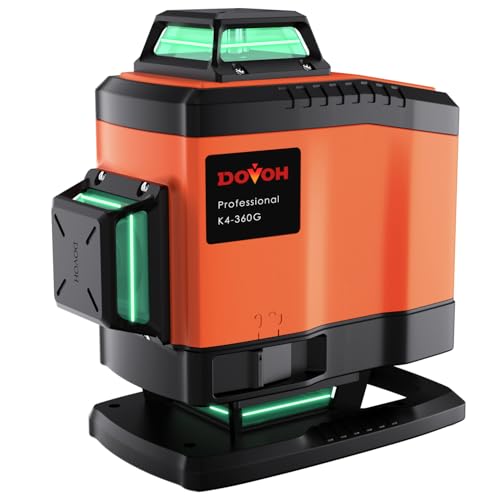
DOVOH K4-360G 4D Green Beam Laser Level
More On The Choices That Made The List
The H3-360G-KIT targets outdoor layouts where direct sunlight weakens the visible beam. Its receiver detects the projected signal at a stated operating range of 400 feet, extending the usable distance for foundations, grading, and site development.
That range requires compatible detection equipment rather than a plainly visible beam across the full distance. Compared with the complete H3 kit later in the list, this setup offers a more focused combination of the H3 laser and receiver.
Well-Handled Touches
- Receiver support improves outdoor signal detection in bright conditions.
- The 400-foot receiver-assisted range suits broad site layouts.
- Self-leveling operation reduces repeated manual reference checks.
Practical Considerations
- Expect reduced beam visibility in direct sunlight without the receiver.
- Careful lens cleaning and dry storage help protect the optical surfaces.
Core Details
Built With In Mind
You gain the most from this model on open foundations, grading work, or exterior additions with long sightlines.
Another Choice May Suit
Choose the DOVOH H3 Outdoor Laser Kit with Tripod and Grade Rod when you also need immediate height support and a grading rod.
Outdoor elevation and grade work demand more than a visible laser line. You also need a stable platform and a rod for carrying height to the beam, making the included tripod and dual-unit grade rod central to this kit’s value.
The aluminum tripod supports up to 5 kilograms, and its rubber feet help limit movement during layout tasks. Unlike the receiver-led H3-360G-KIT, this package gives you a more complete setup from the first setup.
The Helpful Details
- The receiver supports outdoor signal detection under bright conditions.
- Green beam visibility makes indoor reference lines easier to follow.
- The grade rod supports elevation transfer and grading layouts.
- Aluminum construction and rubber feet promote stable placement.
Worth Noting
- The larger equipment footprint requires more storage and transport space.
- Outdoor accuracy still depends on proper leveling, clear optics, and an unobstructed signal.
Technical Highlights
Right Fit For
General contractors and site crews handling grading, foundations, and exterior elevation transfers benefit most from the bundled support equipment.
A Better Fit Elsewhere
The DOVOH PV-360G Plumb Dot Laser Level is more direct for interior pipe and fixture alignment that does not require a grade rod.
A plumb dot laser projects a compact vertical reference instead of relying on a long exposed beam. That focused output makes the PV-360G practical for transferring a floor point upward to align pipes, wires, and suspended fixtures.
The self-leveling format simplifies setup, while the plumb-dot emphasis distinguishes it from the four-plane models in this roundup. For plumbing and electrical rough-in, less visual line coverage can be an advantage rather than a limitation.
What Stands Out
- Upward and downward plumb references support overhead-to-floor alignment.
- The focused dot creates a practical transfer point for pipes, wiring, and fixtures.
- Self-leveling behavior reduces manual leveling during routine setup.
Some Limits To Know
- This focused tool does not replace a four-plane laser for broad wall or floor layouts.
- You may find visibility limiting in bright, unfinished interiors.
- Keep the aperture clear and store the tool dry to reduce lens contamination.
Who Will Love This
Plumbers, electricians, and remodelers transferring vertical points across floors and ceilings get the most focused use from this model.
Where Another Pick Shines
Choose the DOVOH K4-360G 4D Green Beam Laser Level for simultaneous horizontal and vertical coverage across a room.
Two horizontal and two vertical planes give you broad reference coverage for walls, floors, cabinets, and ceilings. That geometry makes this kit useful when one project shifts between tile layout, wall installation, and overhead positioning.
Outdoors, the DR1 receiver extends signal detection to a stated 400 feet with the H3 high-power laser. Compared with the H3 Outdoor Laser Kit, this package trades some tripod capacity for four-plane coverage and a grade rod.
Everyday Perks
- Four planes reduce the need to reposition the tool for each orientation.
- The receiver supports outdoor layouts in bright sunlight.
- The grade rod assists with elevation transfer beyond plain line projection.
- Ceiling and floor planes suit distinct installation stages.
Trade Offs
- More planes add visible line clutter in confined rooms.
- The 60.2-inch tripod has less stated capacity than the H3 kit’s support.
- Outdoor use requires the receiver to realize the longer operating range.
Quick Facts
Best Suited To
Renovation contractors moving between interior finishes and sunlit exterior layouts receive the broadest benefit from this bundle.
Reach For A Different Pick When
The DOVOH Y4-360G-KIT 4D Laser Level with Tripod is simpler for indoor crews that do not need a receiver or grade rod.
The Y4-360G-KIT centers the job around a stable interior setup. Two horizontal and two vertical lines cover the broad references needed for tile, wall framing, cabinetry, and ceiling work, while the included tripod removes the need to source support separately.
Its tripod extends to 60.2 inches and supports up to 3 kilograms. Compared with the receiver-equipped 4D kit, this package carries less outdoor equipment and fits crews whose layouts remain mostly under cover.
A Favorable Mix
- Four planes simplify broad interior references.
- The included tripod provides a ready setup for new installations.
- Self-leveling operation supports efficient repositioning between tasks.
- The compact bundle avoids carrying a grade rod and receiver you may rarely use.
Minor Gripes
- Bright outdoor conditions may make visible lines harder to follow.
- The stated 3-kilogram tripod limit warrants attention to the combined load.
- Owners commonly need to wipe dusty optics before checking line visibility.
The Right Fit
Interior finish crews handling tile, walls, and cabinetry gain a straightforward four-plane setup without outdoor accessories.
Consider Something Else When
The DOVOH 4D Laser Level Kit with Tripod and Grade Rod fits outdoor elevation work that requires a receiver and grade rod.
The K4-360G focuses on tool protection and flexible interior coverage. An overmold rubber housing surrounds the body to add impact resistance, which is meaningful during framing, renovation, and repeated transport between work areas.
Its green 4D output supplies two horizontal and two vertical planes, allowing you to establish room-wide references without constant rotation. Unlike the bundled kits, it places more emphasis on the laser body than on outdoor support equipment.
What It Does Well
- Four planes support walls, floors, and ceiling layouts.
- The rubber overmold adds protection in rough renovation settings.
- Green beams provide visible references for detailed interior work.
- The standalone format lets you use your existing tripod and accessories.
Areas To Watch
- No receiver is listed, making the model less suited to extended outdoor detection.
- The four-plane pattern may appear busy in smaller rooms.
- Rubber protection reduces impact concern but does not replace careful transport.
Feature Snapshot
Made For
Renovation professionals needing four-plane coverage and a protective housing benefit most from this standalone configuration.
Swap It Out When
Choose the DOVOH H3 Outdoor Laser Kit with Tripod and Grade Rod for long outdoor detection and complete elevation support.
What Matters Before You Choose
Start with the reference you need. A plumb dot laser concentrates on vertical transfer, while a 4D model projects intersecting horizontal and vertical planes. One serves overhead alignment; the other handles whole-room construction more efficiently.
Sunlight changes the selection. Green beams improve visible-line contrast indoors, but direct outdoor light can still overwhelm them. A receiver detects the laser signal, so you should treat its stated operating range separately from the distance at which you can plainly see the beam.
Bundled support equipment shapes daily use. Tripods provide height and stability, while grade rods help carry elevation references to grading and foundation work. Existing accessories can make a standalone laser more practical than a larger kit.
Accuracy and control also depend on setup habits. Set the tool on a stable surface, keep the aperture clean, confirm the level reading, and allow the working area to remain reasonably clear. Locking controls during transport and storing the unit dry help protect its optical and electronic parts.
Smart Choices for Demanding Layouts
Mistakes Worth Dodging
Do not confuse receiver-assisted range with visible beam distance. A receiver can detect a signal across a long span even when the line disappears from sight. You should also avoid choosing four-plane coverage for a task that only needs one vertical dot.
When Paying More Pays Off
Added value usually comes from practical support, brighter output, outdoor detection, or a protective housing. The upgrade matters most when a crew repeatedly handles long layouts, changing elevations, or renovation environments, rather than occasional interior reference work.
Frequently Asked Questions
What is a laser plumb bob used for?
A laser plumb bob projects a vertical reference point for aligning pipes, wiring, fixtures, walls, and suspended features across floors or ceilings.
Is a 4D laser better than a plumb dot laser?
A 4D laser suits broad room layouts with intersecting planes. A plumb dot laser is more focused for transferring one vertical point between levels.
Can these laser levels work outdoors?
Green beams can be difficult to see in direct sunlight. Models with a compatible receiver offer better signal detection across extended outdoor spans.
What does a receiver do?
A receiver detects the laser signal and identifies the beam’s elevation on a staff or rod. This remains useful when the visible line becomes difficult to follow in bright conditions.
Do I need a tripod with a laser level?
A tripod provides adjustable height and a stable reference, making it valuable for repeated construction layouts. You can use a stand only when it meets the laser manufacturer’s support requirements.
