
A vertical reference matters while hanging cabinets, aligning shelves, setting posts, or transferring a level point across a work area. Traditional plumb bobs deliver dependable gravity-based references, while self-leveling lasers project horizontal, vertical, or rotating planes for faster layout.
The right choice depends on your workspace, required range, and appetite for setup. The six options below cover everything from a compact hand-tool kit to rotary and cross-line laser systems.
The Lineup, Simplified
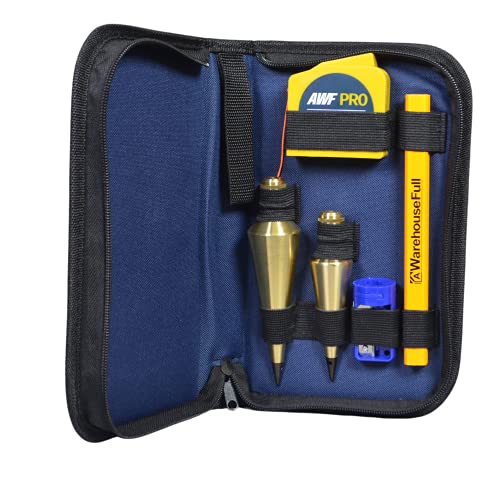
AWF PRO Brass Plumb Bob Kit

Johnson JRT300-RDHV-S Rotary Laser System

Huepar Pro ZK04CG-LR300 Laser Level Set

Huepar Pro ZK04CG 4D Laser Level

Huepar Pro GS03CG 3D Laser Level

Relaxweex Hexagon Steel Plumb Bob
A Closer Look At Each Pick
For cabinet installation, shelving, and post layout, the AWF PRO kit supplies the basic gravity reference without a powered laser. Its two solid-brass weights provide 8-ounce and 16-ounce options, while a 14-foot retractable reel keeps the nylon line controlled around doors, walls, and workbenches.
The magnetic base gives the reel a useful home on many metal surfaces, which can be handy in a workshop or renovation. Unlike the Huepar Pro ZK04CG farther down this list, this is a precise hand-tool approach that stays silent during use and needs no batteries.
Good Reasons To Consider
- Two brass weights let you adapt to lighter cabinetry or heavier structural work.
- The 14-foot reel reduces tangled line during repetitive vertical checks.
- A magnetic base keeps the reference point accessible on suitable metal surfaces.
- Replaceable steel tips cover wear from repeated contact with hard floors.
- The zippered case protects the set during transport between jobs.
Practical Considerations
- Clear surface debris from the tip before each reference check.
- The magnetic base won’t hold reliably on every painted or nonmetal surface.
Made For Cabinet Installers
You benefit most from this kit during hands-on installation work that needs a quiet, battery-free vertical reference.
A Better Fit Elsewhere
Huepar Pro GS03CG suits you better when you need projected lines across a larger outdoor work area.
Large-site layout calls for a rotating laser, which projects a moving horizontal plane around the work area. The Johnson JRT300-RDHV-S covers up to 4,000 feet and supports dual-slope work, making it more relevant to grading, foundations, and broad exterior alignment than cabinet installation.
The included tripod, grade rod, detector, target, remote, and rechargeable batteries create a more substantial setup than the AWF PRO kit. A rotary laser is self-leveling, meaning its internal mechanism establishes the horizontal reference automatically after setup.
A Strong Showing
- The 4,000-foot range suits large properties and extended site layouts.
- Five rotational speeds support different setup and measurement routines.
- Remote operation reduces repeated trips between the instrument and receiver.
- The detector helps locate the rotating beam in brighter or wider spaces.
- A grade rod supports elevation transfer during grading tasks.
Things To Consider
- Expect more setup time and carrying weight than a simple plumb bob.
- Red beams can be harder to follow in bright ambient light.
Built With Large Crews In Mind
You gain the most from this system on expansive construction sites or extensive grading projects.
Where A Sibling Pick Shines
Huepar Pro ZK04CG-LR300 serves you better for compact cross-line work with receiver-assisted outdoor alignment.
The Huepar Pro ZK04CG-LR300 projects 16 green lines across four 360-degree planes, giving you horizontal and vertical references without the rotating sweep of the Johnson system. That makes it more convenient for wall layouts, framing, and room-scale tile work.
Its receiver extends outdoor use to 660 feet in pulse mode. You select between precision and standard accuracy settings, so the instrument can serve both detailed interior layout and longer exterior alignment, depending on visibility and distance.
What Pays Off
- Four 360-degree planes provide broad wall, ceiling, and floor references.
- Green beams remain easier to distinguish during detailed indoor positioning.
- The receiver extends the usable outdoor distance to 660 feet.
- Rechargeable operation reduces interruptions during full renovation days.
- Two accuracy settings accommodate precision and general leveling.
Small Caveats
- The receiver is necessary for the stated long-distance outdoor range.
- Stored green beams can need a careful wipe after dusty site work.
Right Fit For Outdoor Renovators
You benefit most when combining indoor cross-line accuracy with long exterior layout.
Another Choice May Suit
Johnson JRT300-RDHV-S fits you better for wide-area rotating-plane work with a grade rod.
Interior tile and fixture layouts benefit from the ZK04CG’s full floor-to-ceiling references. It projects two horizontal and two vertical lines, while the lifting base moves the low horizontal reference from 0.83 to 3.2 inches above the surface.
That height adjustment is more useful than it first appears because tile lines must account for the finished surface rather than the empty subfloor. Compared with the ZK04CG-LR300, this model emphasizes close interior work and does not include the receiver-focused outdoor setup.
Useful Strengths
- Four crossing planes support walls, ceilings, and floors.
- The lifting base lets you place the floor line above uneven surfaces.
- A magnetic bracket expands mounting options around metal fixtures.
- Remote and rechargeable-battery features support flexible operation.
Details To Watch
- Green beams may be unnecessary in a small, dark bathroom.
- Confirm the base sits securely before marking finished surfaces.
Who Will Love This
You’ll find this model especially useful for interior tile, trim, and cabinet installation.
Reach For A Different Pick When
Huepar Pro ZK04CG-LR300 fits you better when outdoor receiver-assisted range matters.
The GS03CG focuses on outdoor trim and framing, where small alignment corrections can affect several connected parts. Its pivot-around-point base lets you move a vertical line through a 10-degree adjustment range while keeping the crossing point fixed, which is more controlled than shifting the entire laser.
Three 360-degree green planes and a stated accuracy of 1/13 inch suit detailed layout. Metal window covers, a shock-absorbing rubber shell, and IP54 protection also make it a sensible choice for dusty or damp work areas, though the hard case still matters during transport.
Practical Pluses
- Fixed-point pivot adjustment supports precise vertical corrections.
- Three full planes cover multiple walls around one setup point.
- Metal window covers add structure around vulnerable optical areas.
- The rubber casing offers handling protection on active sites.
- A hard case keeps the laser and accessories together.
Some Limits To Know
- It provides fewer directional planes than the ZK04CG models.
- Dust around the openings can require regular cleaning.
Built With Finish Work In Mind
You benefit most when exterior lines need careful vertical refinement after the main setup.
Look Elsewhere When
Relaxweex Hexagon Steel Plumb Bob suits you better for silent, single-point vertical checks.
The Relaxweex Hexagon Steel Plumb Bob stays focused on one essential task: establishing a vertical reference from a suspended point. It’s useful for wall shelving, cabinet centers, and repetitive shop layouts where a laser would add more equipment than the job requires.
Each listed weight is 8 ounces and has a plated cold-drawn steel body. That construction favors durability and direct handling, although the AWF PRO kit offers a more organized approach with two weight sizes, replaceable tips, and a retractable reel.
Positive Points
- The 8-ounce weight handles routine vertical alignment work.
- Steel construction suits regular workshop and construction-site handling.
- Hexagonal shaping gives you distinct edges to grip.
- Nylon line provides a simple suspended reference.
Possible Compromises
- You manage the line manually without a retractable reel.
- The plated point can develop surface wear through repeated contact.
- A single listed weight offers less versatility than the AWF PRO set.
Made For Minimal Toolkits
You’ll appreciate this option for straightforward vertical checks without powered setup.
Swap It Out When
AWF PRO Brass Plumb Bob Kit fits you better when you want multiple weights and controlled line retraction.
Choosing A Vertical Reference That Fits The Job
Start With The Layout
A plumb bob establishes one vertical line from a physical point. That simplicity makes it useful for cabinets, shelving, posts, and small shop layouts, particularly when you want a battery-free tool that produces no light.
Choose based on the reference you need, not simply the number of lines. Cross-line lasers suit wall and floor layouts, while rotary systems serve broad construction areas with elevation transfer.
Match Range To The Space
A receiver extends the practical distance of a pulse-mode laser, but it also adds another component to position and read. Rotary systems cover larger areas, although their setup and carrying demands are greater.
For most rooms and patios, a compact cross-line laser may be enough. Large foundations, grading, and exterior site control justify a more capable rotary package.
Account For Surfaces And Adjustments
Hanging tools from metal surfaces only works with suitable anchors. Laser adjustments also depend on a stable base, a reasonably level setup point, and enough contrast between the beam and surrounding light.
A lifting base helps on uneven surfaces, while pivot adjustment allows finer vertical corrections. Choose the feature that directly addresses your workspace rather than paying for complexity you will rarely use.
Include The Supporting Tools
A grade rod, tripod, detector, and remote can turn a laser head into a complete layout system. These accessories matter when you regularly transfer elevation or work beyond direct beam visibility.
Traditional plumb bobs need fewer accessories, though a line reel, sharp points, and a carrying case improve daily convenience. Match the whole setup to your workflow and storage space.
Common Layout Tool Decisions
Pitfalls Shoppers Hit
Choosing by line count can distract you from the actual task. Check beam visibility, room size, mounting options, and whether you need a receiver before settling on a model.
You also need to account for accessories and storage. A bare laser head may leave you without a stable support or elevation-transfer tool.
What The Higher Tier Buys
Premium systems tend to add range, rotation, receivers, grading accessories, and stronger site protection. Those additions can reduce repeated repositioning on demanding projects, but they add cost, weight, and setup complexity.
You gain the most from a higher tier when a single tool replaces several manual checks. For occasional interior layout, a simpler plumb bob or cross-line laser may suit your needs more closely.
Frequently Asked Questions
Are plumb bobs better than laser levels for home use? Plumb bobs work well for single vertical references and require no batteries. Laser levels work faster for continuous wall, floor, and ceiling lines.
Which Johnson option covers the largest work area? The Johnson JRT300-RDHV-S has a stated working range of up to 4,000 feet. Its rotating system suits larger construction and grading layouts.
Do I need a receiver for outdoor laser use? A receiver can help locate pulse-mode beams at longer distances. Direct line visibility is often more convenient for close outdoor work.
Are green laser lines stronger than red lines? Green beams are commonly easier for some people to see during indoor layouts. Red rotary systems can cover broader sites, but visibility depends on ambient light.
What weight is easiest for cabinet installation? A lighter plumb bob can react less sharply near cabinets and finished surfaces. The AWF PRO kit gives you 8-ounce and 16-ounce brass options for different tasks.
