
Wire connectors set the foundation for dependable electrical work, yet choosing the wrong style for a terminal, circuit, or repair can waste time and materials. The options here range from reusable lever connectors and winged caps to crimpable DT terminals, low-voltage splices, and a dedicated four-indent crimping tool. This guide helps DIYers, technicians, and vehicle-wiring hobbyists match each connector to the conductor, enclosure, and installation method. Solid and stranded wires, contact gauges, pin counts, insulation requirements, and connector series determine which option makes sense.
The Main Contenders
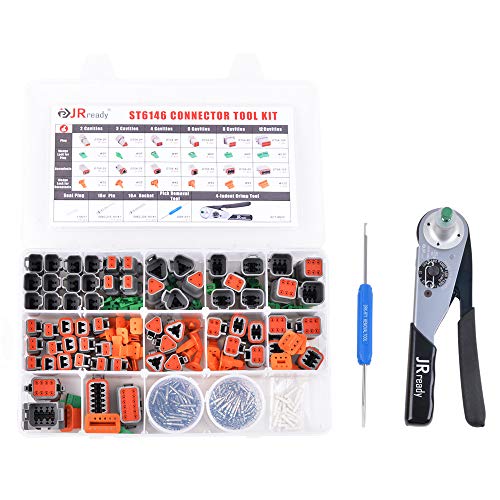
JRready ST6146 DT Connector Kit

Ideal In-Sure Lever Connector 30-01L23, 3-Port

JRready JRD-HDT-48 Crimp Tool

IDEAL 30-451P Yellow Wing-Nut Connectors

JRready ST6118 Size 16 Solid Contact Terminal Kit, 100 Pairs

Ideal 85-925 UR-I IDC Splice Connectors
Taking A Closer Look At The Options
Vehicle repairs and compact control enclosures often need several circuit sizes rather than one connector format. The JRready ST6146 groups two, three, four, six, eight, and twelve-position DT housings with size 16 solid contacts and an ACT-M202 crimper, reducing the number of separate parts carts in a busy garage.
Its IP67-rated housings use PA66 nylon, a material chosen for durability and resistance to moisture exposure. The four-indent, eight-impression crimp creates multiple compression points around each solid terminal, so contact integrity depends on using the correct cavity, conductor size, and crimper setting.
What Works In Its Favor
- Six DT circuit counts support different harness layouts.
- The included crimper removes the need to source a separate tool.
- PA66 nylon housings suit moisture-prone vehicle or equipment wiring.
- Size 16 contacts cover the specified 14-20 AWG range when crimped correctly.
Small Caveats
- Incorrect crimper selection can distort contacts, so keep each terminal paired with its proper cavity.
- These are specialized DT components rather than general household splice connectors.
Key Product Details
Built With In Mind
Technicians restoring vehicle harnesses or assembling weather-exposed control systems benefit most from the broad housing assortment.
Where Another Pick Suits Better
Ideal Industries 30-451P connectors serve routine household branch wiring better when a crimping tool and sealed DT interface are unnecessary.
Three conductors meeting in a control panel is a cleaner fit for this Ideal connector than adding a loose splice and several pieces of tape. Model 30-01L23 combines three wire ports in a compact housing, while the side-access levers sit apart from the insertion openings for easier handling in confined spaces.
Unlike the JRready ST6146, this option does not require a separate crimper. It accepts 12 through 24 AWG solid or stranded copper wire, making it useful for access panels, low-voltage controls, and repeatable assemblies where you may expect to disconnect and reconfigure a connection.
Noteworthy Benefits
- Tool-free lever operation speeds panel work.
- Reusable construction supports future rewiring or inspection.
- Three ports reduce excess wire and crowded splices.
- Both solid and stranded conductors fit the stated range.
Worth Noting
- Each port must be fully populated according to the assembly instructions; unused openings are not a substitute for proper closure.
- The compact body may be harder to grip with thick gloves on.
- It lacks the sealed interface offered by the IP67-rated ST6146.
Technical Sheet
Right Fit
Panel technicians and serious DIYers benefit most from a reusable, tool-free way to join up to three conductors.
Another Choice May Suit
JRready ST6118 contacts serve vehicle harness builders better than a lever connector when individual crimped pins and sockets are required.
A connector shell only performs as intended as its terminals, which makes the JRD-HDT-48 more specialized than the connector sets in most household tool kits. Designed for Deutsch-family solid contacts, it forms a four-indent, eight-impression crimp that compresses the terminal barrel from several directions.
The eight-position selector and screw-adjusted positioner let you align the conductor more consistently, a meaningful advantage during repeated bench or harness work. Depending on your contact geometry, spend time confirming that the terminal sits square in the jaws before applying the full crimp.
Positive Takeaways
- Four-indent crimping supports stable, symmetrical contact compression.
- Eight selector positions accommodate different contact dimensions.
- The screw positioner simplifies alignment during repetitive jobs.
- The stated 12-22 AWG capacity covers a useful range of solid wire.
Practical Considerations
- Dirt or trapped wire strands can damage the crimper jaws, so keep the tool clean and store it with the jaws closed.
- This is a dedicated contact crimper, not a general-purpose stripping and terminal tool.
- Incorrect selector positioning can produce an unsuitable crimp despite a tight tool.
Quick Facts
Whose Shelf It Belongs On
Harness technicians and experienced hobbyists benefit most from its adjustable contact positioning and specialized crimp geometry.
Look Elsewhere When
Beginners assembling simple indoor branch wiring benefit more from the straightforward IDEAL 30-451P Wing-Nut connector.
For everyday branch wiring, recognizability and a broad supply matter more than compact dimensions. The yellow color makes 30-451P connectors easy to distinguish after installation, while the contoured wings provide a surface for twisting the spring connection with controlled hand pressure.
A hundred connectors suit renovation days, property maintenance, or a stocked workshop where several branch circuits need work. The spring expands to accept differing wire combinations, but wire capacity, copper type, and local electrical-code limits still govern acceptable use.
A Favorable Mix
- The large count supports multiple rooms, circuits, and future repairs.
- Winged sides provide useful leverage during assembly.
- Yellow identification makes the connector easy to recognize.
- The spring profile accepts varying wire combinations.
Points To Note
- The open-wing design occupies more interior box space than a compact lever connector.
- These connectors are less suitable for temporary connections because repeated removal can damage wire strands.
- Use only within the wire ranges and applications permitted by local code.
Who Should Grab It
Home maintenance technicians and DIYers handling multiple conventional branch-wire connections benefit most from the generous supply.
Consider Something Else When
The Ideal 30-01L23 serves control-panel work better where reusable connections and three compact ports are the priority.
Building a DT harness one contact at a time can leave your workbench short on matched terminals. The ST6118 supplies 100 pin-and-socket pairs, with 0460-215-16141 male pins and 0462-209-16141 female sockets for HD30 and HDT-series applications.
Nickel-plated copper contacts are built around size 16 service and solid wire from approximately 14 to 16 AWG for these terminals. The JRD-HDT-48 or ACT-M202 can form the recommended four-way style of crimp, although the correct cavity and contact orientation remain essential.
Notable Gains
- One hundred pairs support several complete harnesses.
- Matched male and female contacts simplify circuit-end preparation.
- Nickel plating provides a durable contact surface in protected assemblies.
- Green stripes help distinguish size 16 contacts during installation.
Details To Watch
- Barrel-style solid contacts require a suitable four-indent crimper, which is not included.
- These components must match the housing series and cavity size, so verify connector drawings before assembly.
- Keep contacts organized by size to avoid mixing them with similarly shaped terminal families.
Feature Snapshot
Made For
Vehicle-harness hobbyists and technicians rebuilding multi-pin circuits benefit most from the large matched-contact inventory.
Swap It Out When
The JRready ST6146 kit suits temporary project work better when you also need assorted housings and an included crimper.
Replacing a damaged voice or data conductor does not always justify pulling an entire cable back through a wall. The 85-925 uses insulation displacement connection, or IDC, to establish electrical contact by pressing a solid conductor into a metal contact without stripping the insulation.
Three positions handle butt splices, repairs, and tap arrangements for low-voltage voice or data wiring. It is especially useful for shorter cable runs, but pinching the conductor into the wrong contact can damage insulation or produce a poor connection, so position matters.
What Earns Its Place
- IDC construction removes the stripping step for solid low-voltage wire.
- Three ports support repair and branch configurations.
- The 25-count pack covers several cable corrections.
- A compact splice suits areas where a wing connector would be oversized.
Some Limits To Know
- You cannot reposition a conductor after it is pressed into the contact, so check the path before squeezing the housing.
- These connectors suit solid wire, not stranded conductors.
- Use remains limited to suitable low-voltage voice and data applications.
The Right Fit
Low-voltage installers and advanced DIYers benefit most from a compact, tool-free repair for supported solid conductors.
A Better Fit Elsewhere
The IDEAL 30-451P connector fits conventional copper branch wiring better than this specialized low-voltage splice.
Choosing the Right Connection Method
Start with the wire rather than the connector color. Confirm whether the conductor is solid or stranded, measure its gauge, and check the connector’s permitted range. AWG, or American Wire Gauge, measures conductor diameter, but a higher gauge number indicates a smaller wire; never force a conductor into an opening that appears close in size.
Match the connector to the job
A conventional branch circuit may suit a winged spring connector, while a repeatable control-panel junction benefits from a compact lever connector. DT-style housings and crimped contacts suit vehicle harnesses, control systems, and other applications where a defined pin layout and environmental enclosure are required. Verify the connector series before inserting any contact.
Consider installation conditions
A dry indoor enclosure does not demand the same environmental resistance as a vehicle compartment or equipment cabinet. Moisture, vibration, conductor movement, and service access affect the practical choice. Secure the cable, respect the manufacturer’s assembly instructions, and follow the local electrical code appropriate to the circuit.
Match the tool to the terminal
Crimp connectors require the correct tool, die, and contact cavity. A four-indent tool does not automatically suit every terminal family, and a broad crimper can form a poor connection inside a precision contact. Keep the tool clean, store the jaws under control, and inspect the finished crimp according to the terminal maker’s criteria.
Details That Prevent Costly Mismatches
Mistakes Worth Dodging
Do not select a connector from wire color or gauge alone; contact material, construction, conductor type, and application must agree. Avoid mixing contacts from similar-looking connector series, and do not use a low-voltage IDC splice where a code-compliant branch connection is required. Disconnect and verify the circuit according to local safety procedures before disturbing energized wiring.
When Paying More Pays Off
A higher-tier kit can justify its cost through specialized dies, broader pin assortments, or contacts paired with an enclosure. Those additions matter for repeated harness work, while a straightforward household repair may need only a few winged connectors. Match the expenditure to the number of circuits and the precision your installation requires.
Frequently Asked Questions
Can lever wire connectors handle stranded wire?
The Ideal 30-01L23 accepts solid and stranded wire from 12 through 24 AWG. Confirm the strip length and follow the assembly instructions so every conductor seats correctly.
Are DT connectors suitable for vehicle wiring?
The JRready ST6146 housings have an IP67 rating and suit protected vehicle or equipment wiring. Correct crimping, sealing, strain relief, and circuit protection remain necessary.
Which connector is easiest for routine branch wiring?
The IDEAL 30-451P uses a winged spring connection and accepts varying conductor combinations. Local code, conductor count, box space, and application requirements still apply.
What is an insulation displacement connection?
An IDC connector presses a solid conductor into a metal contact without stripping its insulation. It suits supported low-voltage voice and data wiring rather than conventional branch circuits.
Do I need a crimping tool for solid contacts?
Yes, contacts from the ST6118 kit need a suitable four-indent crimper, such as the JRD-HDT-48 or ACT-M202. The correct terminal cavity and tool setting are essential to the finished connection.
