
A dependable multimeter turns a pile of readings into a clear diagnosis, yet the wrong category or capacity can leave important gaps. Electricians, technicians, solar installers, and serious DIYers need accurate measurements in compact packages that can move from a service van to a panel enclosure without slowing the job. The Ideal Electrical 61-357 handles broad electrical diagnostics, while the matching case protects it in transit. Four Elejoy instruments cover specialized photovoltaic measurements, with panel capacity and field portability determining the right fit.
A Fast Comparison Of The Options
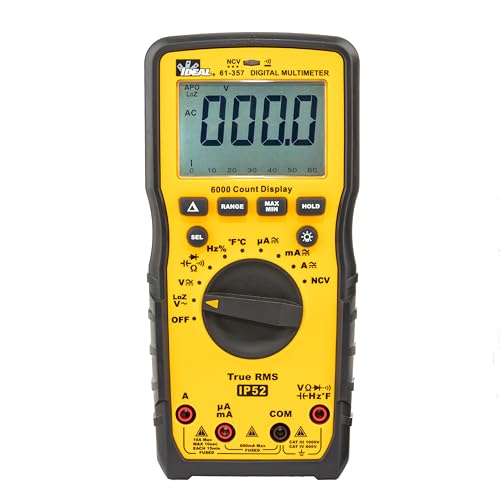
Ideal Electrical 61-357 Multimeter

Ideal Electrical Multimeter Carrying Case
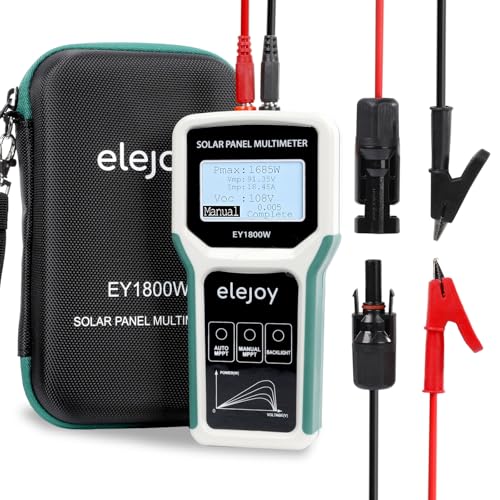
1800W MPPT Solar Panel Tester

400W Photovoltaic PV Multimeter

1600W MPPT Solar Panel Tester

800W Digital PV Multimeter
Taking A Closer Look At The Options
Day-to-day electrical work rarely stays within one measurement type. The 61-357 combines voltage, current, resistance, continuity, capacitance, diode, frequency, and temperature functions, so a technician can move from a failed outlet to a motor-control cabinet without carrying several instruments.
Its autoranging display reduces manual range selection, while true root mean square measurement is useful for diagnosing non-sinusoidal waveforms found in modern electronics and motor drives. For electricians working around service equipment, the CAT IV 600V and CAT III 1000V ratings supply useful installation context. The solar testers later in this list serve a narrower photovoltaic purpose, so the 61-357 remains the stronger general-purpose option.
The Helpful Details
- Broad function coverage consolidates routine electrical diagnostics into one instrument.
- Up to 10 amps of AC and DC current measurement supports common branch-circuit and equipment checks.
- Low-impedance AC voltage mode provides another useful view when troubleshooting loaded circuits.
- Temperature measurement in Fahrenheit and Celsius reduces reliance on a separate probe.
Points To Keep In Mind
- Current measurement requires placing the test leads in series with the circuit, so safe circuit isolation remains essential.
- Its broad case and accessory set may occupy more space than a dedicated solar meter.
Key Specs
Built With In Mind
Licensed electricians, facilities technicians, and advanced DIYers benefit most from its combination of electrical functions and safety ratings.
A Better Fit Elsewhere
Solar installers focused on photovoltaic output gain more from the 800W Digital PV Multimeter than this general-purpose electrical model.
A capable meter can still become job-site debris after it slides across a van floor or gets dropped between accessories. This carrying case gives the Ideal Electrical 61-357 a dedicated place in a mobile tool kit, reducing loose storage and making the instrument easier to retrieve between calls.
Unlike the Elejoy solar meters, this is an accessory rather than a measuring device. Its value comes from compact transport and physical protection, particularly for technicians who regularly move between homes, service rooms, and commercial panels. You still need to secure leads and accessories inside the case, since the shell alone won’t prevent tangling or a misplaced probe.
Where It Delivers
- A dedicated case reduces contact with loose tools, dust, and other van contents.
- The compact shape suits a toolbox, service bag, or work-vehicle storage area.
- Matching the intended multimeter supports a more orderly mobile kit.
Worth Noting
- This case does not add electrical measurement functions or diagnostic capability.
- Confirm the case accommodates your specific meter and the full set of leads you regularly carry.
The Right Fit
Mobile electricians and service technicians who regularly carry the compatible Ideal meter will gain the most practical benefit.
Another Choice May Suit
Homeowners working at a stationary bench can direct their spending toward the 61-357 itself rather than a protective carrying case.
Residential solar troubleshooting calls for more than a quick voltage check. Maximum power point tracking identifies the operating point where a panel delivers its greatest output, while open-circuit voltage and short-circuit current help characterize its electrical condition.
The 1800W MPPT Solar Panel Tester targets higher-output photovoltaic work, making it more relevant than the 400W model for installers handling larger residential arrays. The trade-off is specialization: it does not replace the broader AC, resistance, and current functions of the Ideal Electrical 61-357. For field work, its battery-free connection and compact EVA kit reduce the number of separate items you must carry.
Points In Its Favor
- MPPT tracking shows real-time panel output at the maximum available power point.
- Open-circuit voltage and short-circuit current readings support more complete panel diagnostics.
- The 1800W range provides useful headroom for larger residential photovoltaic configurations.
- Its field-oriented kit needs no batteries, simplifying setup at rooftops and remote arrays.
Small Caveats
- Its narrow photovoltaic focus leaves general household electrical work to a conventional multimeter.
- Field leads and connectors require orderly storage after use to prevent avoidable wear.
Feature Snapshot
Made For
Residential solar technicians and advanced installers handling larger 12- and 24-volt panel systems will find the capacity especially relevant.
Consider Something Else When
Technicians maintaining only a small 400W array may find the 400W Photovoltaic PV Multimeter easier to justify.
Small solar installations reward a meter that stays out of the way. At 460 grams, the 400W Photovoltaic PV Multimeter is positioned for homeowners and maintenance technicians who inspect a limited panel count rather than a sizable residential array.
Its MPPT function locates the panel’s peak operating point, which can reveal output changes associated with shading or damage. The 12- and 24-volt scope fits common small-scale systems, but it offers considerably less capacity than the 800W and 1800W Elejoy choices. In practice, matching the meter to your installed capacity matters more than carrying extra range.
Good Reasons To Consider
- The 460-gram housing is easy to carry between a rooftop, garage, and small equipment enclosure.
- MPPT tracking helps identify performance loss that a simple open-circuit reading may miss.
- Support for 12V and 24V systems covers many compact residential and off-grid installations.
Practical Considerations
- The 400W ceiling may be limiting for installers who regularly move between larger arrays.
- The LCD needs suitable ambient light for comfortable reading during extended field work.
- Keep the connected leads from kinking or collecting moisture between maintenance visits.
At A Glance
Whose Shelf It Belongs On
Home solar maintainers and small-system technicians will appreciate the manageable weight and focused 400W capacity.
Reach For A Different Pick When
Installers servicing panels above 400W benefit more from the 800W Digital PV Multimeter and its wider range.
The 1600W MPPT Solar Panel Tester sits between the 800W and 1800W Elejoy models, giving technicians meaningful capacity without carrying the highest stated limit. Maximum power point measurements, open-circuit voltage, and short-circuit current provide a practical diagnostic set for residential panel maintenance.
Its battery-free design keeps field setup straightforward, particularly on a roof or at a remote enclosure. Compared with the 400W Photovoltaic PV Multimeter, the extra range suits arrays that would exceed a compact system. You still need to connect the instrument correctly and operate within its electrical limits, and it remains more specialized than the Ideal Electrical 61-357.
Notable Upsides
- The 1600W limit accommodates larger residential systems with useful measurement headroom.
- MPPT output data helps distinguish underperforming panels from a weak reading caused by conditions elsewhere in the array.
- Voc and Isc measurements add useful context during panel installation and fault isolation.
- No battery requirement reduces field preparation and battery-management concerns.
Possible Compromises
- Homeowners with a small array may never approach the stated measurement range.
- The product cannot handle the general resistance and AC diagnostics expected from a standard electrical multimeter.
Who It Suits Best
Installers and service technicians who routinely work on medium-to-large residential solar arrays are the strongest match.
Where A Sibling Pick Shines
Specialists crossing the stated 1600W threshold may prefer the 1800W MPPT Solar Panel Tester for added capacity.
Many residential solar arrays fit neatly between the compact 400W unit and the larger 1600W model. The 800W Digital PV Multimeter occupies that middle ground, with MPPT tracking for locating maximum output and stated limits of 12-60V Voc and 0-35A Isc.
Voc is open-circuit voltage, while Isc is short-circuit current; both help characterize a panel outside its normal operating condition. That makes this instrument useful for shading, dirt, and suspected cell-damage investigations. Compared with the 61-357, the specialized ranges provide more direct photovoltaic diagnostics, though you sacrifice broader household electrical functions.
Useful Highlights
- MPPT tracking helps locate the panel’s maximum power point during real operating conditions.
- The 12-60V voltage span supports a broader range of residential photovoltaic systems.
- A 0-35A current range gives technicians more room when diagnosing connected solar equipment.
- The 800W limit offers a practical balance between the 400W and 1600W Elejoy options.
Less Ideal Details
- Reaching its voltage or current ceiling is still possible, so panel ratings should guide the connection.
- Diagnostic readings depend on correct lead placement and stable field conditions.
Technical Highlights
The Right Fit
Residential solar maintainers needing broad voltage and current coverage without a 1600W-class instrument are a strong match.
Not Your Match When
Large-array specialists may prefer the 1800W MPPT Solar Panel Tester for its higher stated capacity.
Matching Measurement Tools To Real Electrical Work
Choosing by panel count alone misses the bigger picture. A useful instrument must match both the measurements you perform and the environment where you perform them, so the right choice for a rooftop array may be wrong for a crowded service panel.
Confirm The Measurement Category
A general electrical multimeter should cover voltage, current, resistance, continuity, and the component checks common to wiring diagnostics. True root mean square measurement is valuable around electronics, inverters, and motor drives, where distorted AC waveforms can make a basic average-response reading less informative. You also need CAT ratings that suit the installation environment rather than relying on the voltage figure alone.
Match Solar Capacity Before Connecting
Photovoltaic meters are built around a panel’s maximum power point, open-circuit voltage, and short-circuit current. Voc represents the voltage present without current flowing, while Isc describes the current available under a short-circuit condition; both remain electrical measurements requiring careful, controlled work. Match the stated wattage and voltage ranges to your array, especially across a 12-60V system or a panel group approaching the current ceiling.
Think About The Tool Kit
Portability affects daily usefulness more than many shoppers expect. A technician climbing onto a roof benefits from a light housing and battery-free setup, while a van-based electrician may prioritize a general meter and a protective case. Verify lead lengths, connector fit, display readability, and storage arrangements before settling on a model.
Meter Choices That Fit The Job
Pitfalls Shoppers Hit
A wide display does not guarantee the measurements you need, and a high wattage label only makes sense for a photovoltaic tool. Many mistakes begin with selecting on range alone, then discovering the meter lacks current, temperature, capacitance, or accurate AC readings. Confirm connector compatibility, measurement limits, and operating environment before ordering.
What The Extra Money Goes
Higher-category instruments spend that extra capacity on specialized ranges, higher voltage or current limits, and diagnostics aimed at particular equipment. A broader photovoltaic meter earns its place when your work regularly crosses its stated limits; a general electrical model makes more sense for outlets, lighting, controls, and household circuits. Choose the capability you can use rather than capacity you may rarely approach.
Frequently Asked Questions
Are Ideal Industries Digital Multimeters Suitable For Household Repairs?
The Ideal Electrical 61-357 covers voltage, current, resistance, continuity, and several component measurements, making it relevant to many household electrical tasks. Work on energized circuits still requires appropriate training, precautions, and sound inspection practices.
What Does MPPT Mean In A Solar Panel Tester?
MPPT identifies the operating point where a solar panel produces its highest power output. That reading can help you evaluate performance under real conditions such as shading.
Which Solar Tester Handles The Largest Panels?
The 1800W MPPT Solar Panel Tester has the highest stated wattage capacity in this selection. The 1600W and 800W options suit progressively smaller photovoltaic systems.
Does The 61-357 Replace A Solar-Specific Meter?
No. The 61-357 provides broader electrical measurement functions, while the Elejoy models focus on photovoltaic power, voltage, and current behavior. Your choice depends on whether you diagnose general circuits or solar panels.
Is The Ideal Electrical Carrying Case A Measurement Device?
No. It is a protective transport accessory designed for compatible Ideal Electrical multimeters. It improves storage and portability but does not perform any electrical measurements.
