
A clamp meter lets you measure current through a conductor without opening a circuit, which makes it valuable for diagnosing overloaded circuits, motors, HVAC equipment, and vehicle electrical systems. The six options below cover everything from compact household troubleshooting to high-current industrial work, with differences in jaw design, current capacity, voltage range, and measurement functions.
True RMS, short for true root mean square, helps the meter represent AC waveforms accurately. You also need NCV, or non-contact voltage detection, only as a secondary aid because confirming a circuit requires appropriate test leads and procedures.
A Fast Comparison Of The Options

IDEAL 61-405 Split Jaw Clamp Meter

Klein Tools CL910 2000A AC/DC Clamp Meter
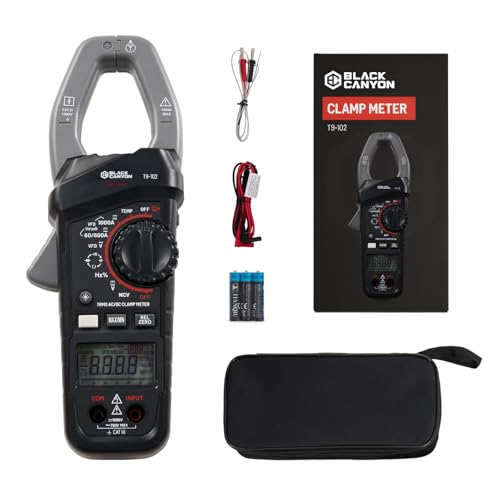
BLACK CANYON 1000A AC/DC TRMS Clamp Meter

KAIWEETS D-Shaped 4000-Count Clamp Meter

KAIWEETS Compact 200A AC/DC Clamp Meter

Neoteck 9999-Count 1000A Color Clamp Meter
A Breakdown Of The Leading Choices
Split-jaw construction makes the IDEAL 61-405 practical for conductors that a conventional closed clamp cannot close around. That matters in crowded electrical panels and on bundled vehicle wiring, where you may need a firmer grip without fully disconnecting a component.
The meter measures up to 200 amps of AC current through its jaws while covering 600 volts AC or DC through the included test leads. Compared with the higher-capacity models later in this roundup, it favors routine residential and automotive diagnostics over heavy industrial circuits.
Useful Highlights
- The hinged fork opens around a conductor while maintaining an upright reading position.
- Auto-ranging reduces manual range selection during mixed residential and vehicle diagnostics.
- The included leads extend the meter beyond current measurement to resistance, continuity, capacitance, diodes, and voltage.
- NCV detection in the right fork can help screen an inactive conductor before you attach the leads.
- The large display keeps readings legible in a garage or beneath a vehicle access panel.
Points To Keep In Mind
- The 200-amp fork capacity makes it less suitable than the Klein CL910 or Neoteck for high-current electrical infrastructure.
- Keep the jaws and internal hinge clean, since dust and grit can restrict opening after repeated field use.
Key Specs
Who It Suits Best
This model fits residential technicians, automotive troubleshooters, and advanced hobbyists handling branch circuits and vehicle wiring.
Another Choice May Suit
Choose the Neoteck 9999-Count 1000A Color Clamp Meter for higher current capacity, drive-focused modes, and a color display.
The CL910 covers a much larger electrical envelope than the IDEAL 61-405, reaching 2,000 volts and 2,000 amps. That scale suits solar arrays, wind equipment, feeder circuits, and power distribution work where a household clamp meter can be undersized before you open the panel.
True RMS auto-ranging reduces setup during changing loads, while the backlit display and integrated worklight help in mechanical rooms and utility spaces. The magnetic hanger and lead holder leave your hands free, although that convenience depends on having a suitable metal surface nearby.
What It Does Well
- The 2,000-amp capacity handles large equipment and distribution conductors.
- A 2,000-volt range reduces meter swapping during industrial diagnostics.
- Auto-ranging simplifies transitions between low-current accessory circuits and heavy loads.
- The worklight improves visibility inside dim enclosures.
- Lead storage and magnetic placement reduce cable clutter at service points.
Trade Offs To Consider
- Its size and weight may be less comfortable than the compact KAIWEETS 200A model during prolonged residential work.
- Lead holders can retain dust or grit, so periodic cleaning helps maintain reliable contact.
- The broad voltage rating should never be treated as permission to exceed the circuit or your training.
Technical Highlights
Made For
You benefit most from the CL910 as a technician working on solar, wind, industrial machinery, or high-current distribution systems.
A Better Fit Elsewhere
The KAIWEETS Compact 200A AC/DC Clamp Meter is easier to carry for home maintenance, automotive work, and tightly packed tool bags.
The BLACK CANYON model fills the middle ground between the 200-amp KAIWEETS compact meter and the Klein CL910’s 2,000-amp range. Its clamp measures AC or DC current up to 1,000 amps, a practical ceiling for many industrial motors, compressors, and service feeds.
You also get AC voltage to 750 volts and DC voltage to 1,000 volts through the lead-based functions. For plant maintenance, that mix of current, voltage, resistance, continuity, frequency, duty cycle, capacitance, diode, temperature, and NCV functions can reduce tool changes during a long diagnostic session.
Real-World Strengths
- The 1,000-amp limit covers substantially more equipment than the compact 200-amp model.
- True RMS supports more meaningful AC measurements on variable and distorted loads.
- Inrush-current measurement helps evaluate startup demand on motors and compressors.
- Temperature and frequency functions extend the meter beyond basic current tracing.
- A backlit LCD improves readability around machines and service panels.
Where It May Fall Short
- The 1,000-volt DC ceiling falls short of the CL910’s stated 2,000-volt envelope.
- Wide feature coverage can make controls less intuitive until you establish a routine.
- Jaw residue and panel dust should be wiped away after use to preserve clean contact surfaces.
Who Will Love This
This meter suits industrial maintenance personnel who regularly measure motor loads, high-current equipment, and several electrical parameters during one visit.
Look Elsewhere When
The IDEAL 61-405 Split Jaw Clamp Meter is a stronger fit when a hinged fork around a large conductor matters more than 1,000-amp capacity.
The D-shaped jaw gives this KAIWEETS model a more deliberate approach to conductor fit than the round compact design seen later. It targets household circuits, vehicle systems, solar troubleshooting, and light industrial equipment without taking on the larger frame of the 1,000-amp options.
Auto-ranging and a 4,000-count display handle routine resistance, voltage, current, continuity, diode, capacitance, frequency, temperature, and NCV tasks. The included thermocouple supports temperature checks, while the flashlight and backlight are practical around engine bays and recessed panels.
A Few Highlights
- AC and DC current measurement supports both household and automotive troubleshooting.
- The D-shaped opening is suited to conductors that benefit from a broad, close fit.
- Temperature measurement adds value during motor, HVAC, and equipment diagnostics.
- Auto-ranging reduces manual changes across common field measurements.
- Dual lighting features help in dim work areas without relying solely on the display.
Small Caveats
- Its 4,000-count resolution sits below the Neoteck’s 9,999-count display.
- For unusually large service conductors, you may find the D-shaped jaw less accommodating than the split fork on the IDEAL.
- Accessory thermocouple leads need careful storage so their connectors remain clean.
Key Attributes
The Right Fit
You get the most from this model as a mixed-skill technician or serious hobbyist handling household circuits, vehicles, solar systems, and equipment maintenance.
Where A Sibling Pick Shines
The BLACK CANYON 1000A AC/DC TRMS Clamp Meter is the better fit for 1,000-amp service work and dedicated inrush-current measurements.
This compact KAIWEETS model focuses on the conductor sizes most often encountered during home maintenance, vehicle repair, and equipment servicing. Its round jaw is designed to close around uneven diameters, from household wiring to thick power cables, without the bulk associated with industrial clamp meters.
The 200-amp AC/DC ceiling closely matches the IDEAL 61-405, although this meter uses a conventional round jaw rather than a split fork. True RMS support is useful for modern electronic loads, but the smaller capacity means you will eventually need another meter for main feeds and heavy machinery.
Advantages To Know
- Compact handling suits small service kits and vehicle diagnostic storage.
- The round jaw accommodates both thin branch wiring and heavier cables.
- AC/DC current measurement broadens its use beyond ordinary household outlets.
- True RMS improves representation of nonlinear AC waveforms.
Less Ideal Details
- The 200-amp ceiling excludes many industrial feeders, large motors, and service conductors.
- Its round jaw may offer less clearance than the IDEAL split fork on bulky conductors.
- Open panel work requires careful storage to keep the hinge and contact surfaces free of grit.
Built With In Mind
This meter fits home technicians, automotive service providers, and enthusiasts who value portability over maximum current capacity.
Swap It Out When
You should move to the Klein CL910 for renewable systems, heavy machinery, or electrical work extending to 2,000 volts and 2,000 amps.
The Neoteck combines a 9,999-count display with a 1,000-amp clamp, giving it more display detail than the BLACK CANYON while remaining lighter in concept than the 2,000-amp Klein. That balance makes it sensible for motor controls, industrial panels, HVAC systems, and modern electronic equipment.
Its stated CAT III 1000-volt and CAT IV 600-volt ratings place it in environments with different transient exposure categories, so the appropriate category matters for your installation. True RMS, low-impedance measurement, VFD support, and an inrush mode target loads where a basic clamp can display a misleadingly high result.
A Few Strong Suits
- The 9,999-count display offers greater numerical detail for many diagnostic readings.
- A 1,000-amp clamp covers substantial industrial and HVAC current demands.
- Low-impedance mode helps reduce the influence of high circuit impedance on AC readings.
- VFD support makes the meter more relevant for modern motor-drive systems.
- The color screen improves separation of readings, modes, and alerts.
Details To Watch
- The extra display detail does not improve accuracy by itself, so understand the selected mode and range.
- Color indicators still need interpretation and should never be treated as a substitute for correct setup.
- Clean the jaw surfaces and remove moisture from the case after outdoor or industrial use.
Quick Facts
Whose Shelf It Belongs On
This model belongs in an industrial technician’s kit for motor drives, HVAC equipment, main panels, and other high-current electrical systems.
Another Choice May Suit
The KAIWEETS Compact 200A AC/DC Clamp Meter serves you better when portability and routine conductor measurements matter more than industrial capacity.
What Matters Before You Choose A Clamp Meter
Match Current To The Circuit
Start with the largest conductor you expect to measure, not the smallest household load. A 200-amp meter suits branch circuits, compact vehicle systems, and many HVAC components, while 1,000-amp models cover heavier machinery. High-voltage service work requires checking the stated voltage range and transient category as closely as current capacity.
Check Jaw Geometry And Access
A split fork can reach conductors that stop a conventional jaw from closing. Round jaws accommodate common round and rectangular wiring, while a D-shaped opening targets a close fit. In crowded panels, the deciding factor may be the distance between terminals rather than jaw capacity alone.
Prioritize The Measurements You Use
True RMS helps with AC loads containing distorted waveforms, while inrush mode targets startup surges. Low-impedance readings can clarify measurements on circuits with substantial impedance, and VFD modes suit modern motor drives. Extra functions are useful only when they correspond to the equipment you actually diagnose.
Consider Display And Handling
A backlight helps inside dark enclosures, while a color display can separate operating modes and alerts. Compact meters are easier to carry between vehicles and rooms, but heavier industrial models may feel more substantial in service settings. You also need to account for probe storage, jaw cleaning, and a protected location for the meter between calls.
A Few Details That Change Your Choice
Where Shoppers Go Wrong
Choosing only by maximum current can leave voltage range, transient category, or jaw access overlooked. Check the conductor diameter and available clearance before committing, and confirm that the functions you need are measured through the clamp or included leads.
What The Extra Spending Delivers
Higher-end models often add higher counts, specialized modes, brighter displays, or broader electrical ranges. That expansion earns its place when you service variable-frequency drives, heavy machinery, renewable systems, or high-current distribution equipment rather than ordinary branch circuits.
