
An HVLP sprayer, or high-volume low-pressure sprayer, breaks paint into a fine mist with reduced air pressure and moderate overspray. That makes these tools useful for furniture refreshes, wall projects, fences, cabinets, and automotive touch-ups, but the right choice depends on paint type, project size, and how much control you need. Some models are electric and self-contained, while air-powered guns require a separate compressor. Your best option depends on whether you value larger capacity, detailed adjustment, simple cleanup, or broader material compatibility.
The Essentials At A Glance

Wagner Spraytech Control Pro 130 HEA Sprayer

WORKPRO 600W HVLP Paint Sprayer 4-Nozzle Kit

THkur Mini HVLP Air Spray Gun Kit
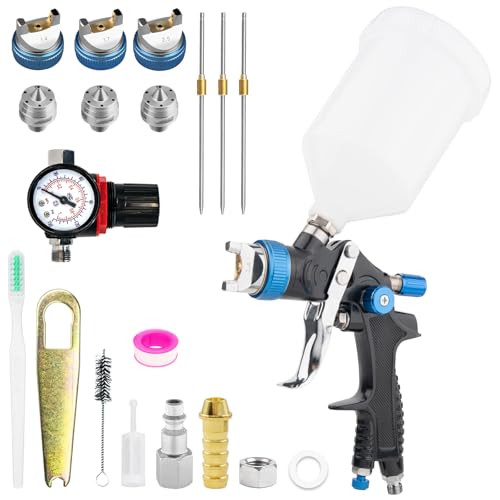
RRJ HVLP Gravity Feed Spray Gun

Wagner Spraytech Control Spray QX2 Stain Sprayer

Wagner Spraytech FLEXiO 570 iSpray Sprayer
Why These Options Stand Out
Large siding jobs and broad decks call for more throughput than a small furniture sprayer can comfortably provide. The Control Pro 130 uses airless spraying, which pushes coating through a pressurized tip at higher pressure than an HVLP gun, making it a different tool from most entries in this list despite the shared paint-sprayer category.
It suits experienced DIYers working across medium to large interior or exterior surfaces with a range of unthinned paints and stains. Compared with the FLEXiO 570, it emphasizes faster broad coverage rather than compact handling, and that trade-off is meaningful on a busy weekend.
The Case For It
- Continuous spraying supports demanding exterior walls, siding, and deck-staining projects.
- Handles a broad selection of paints and stains, reducing equipment changes between jobs.
- High-volume delivery is useful for homeowners covering substantial connected surfaces.
Practical Considerations
- Its airless operating method creates more overspray and demands careful masking, ventilation, and distance control.
- Cleaning and storage require more attention than a compact air-fed touch-up gun.
Key Attributes
Built For Large Homes
You benefit most from this model on extensive exterior painting, siding, or deck-stain projects where continuous application matters.
A Better Fit Elsewhere
Wagner Spraytech FLEXiO 570 suits indoor projects and smaller surfaces where maneuverability matters more than airless output.
Project variety favors a kit that can move from cabinet doors to fences without relying on one fixed setup. WORKPRO pairs a 600-watt electric motor with a 44-fluid-ounce container, giving you an integrated sprayer that needs no separate air hose or compressor.
For first-time users, that simplicity is meaningful, although technique still determines the finish. Unlike the THkur mini gun, this model offers greater capacity and broader nozzle choices, making it more practical for whole-room or outdoor DIY work.
Noteworthy Benefits
- Four 1.5, 1.8, 2.2, and 2.6 mm nozzles support different material volumes.
- Horizontal, vertical, and circular patterns suit walls, trim, and rounded furniture.
- The 44-ounce cup reduces refills during medium-sized projects.
- Electric operation avoids compressor setup and air-hose management.
Small Caveats
- Four nozzle options can feel excessive for a single small furniture project.
- The relatively large cup needs careful balancing during extended use.
Feature Snapshot
Made For Varied Projects
New DIYers benefit from the electric setup, useful capacity, and multiple spray options for furniture, walls, doors, and fences.
Consider Something Else
THkur Mini HVLP Air Spray Gun Kit better fits detailed automotive touch-ups where a small 125 cc cup and precise adjustment matter.
Small touch-up work does not require a large reservoir, and that is where this THkur kit separates itself from the WORKPRO. Its 125 cc cup, compact layout, and 0.8 mm and 1.0 mm nozzles favor controlled application on smaller components.
Three independent adjustments cover spray pattern, fluid flow, and airflow. Those controls make the gun relevant to automotive corrections, hobby pieces, and furniture details, though you will need a suitable air supply because it is not a self-contained electric unit.
Where It Helps
- Independent pattern, fluid, and air controls support deliberate coating adjustments.
- Round and fan patterns suit curved parts and broader localized sections.
- The compact cup makes automotive touch-ups and small craft work less cumbersome.
Things To Consider
- Air-powered operation requires a compatible compressor and correct airflow.
- You may find 125 cc too small for a wall or deck because refills become frequent.
- Residue can dry inside adjustments and passages, so prompt rinsing matters.
Who Will Love This
Automotive hobbyists and detail-focused DIYers benefit from the small reservoir and adjustable spray controls.
Reach For A Different Pick
WORKPRO 600W HVLP Paint Sprayer serves larger household projects better with electric power, a 44-ounce cup, and four nozzle sizes.
A gravity-feed gun uses the weight of the paint in the cup to move coating toward the nozzle, while the accompanying regulator manages incoming air. That arrangement makes the RRJ option more workshop-oriented than the compact THkur kit, with three choices for adapting the spray to the workpiece.
The 1.4, 1.7, and 2.5 mm nozzles span finer work through broader coverage. According to the supplied product information, the one-piece aluminum body, stainless steel nozzle, and brass air cap suit automotive refinishing, furniture, walls, sheds, and fences, provided paint is filtered and adjusted as required.
What Helps Most
- Three nozzle sizes let you vary output for detail work and larger surfaces.
- The metal body and metal nozzle components suit repeated workshop use.
- Water-based and oil-based paint compatibility broadens project options after proper preparation.
- The included regulator supports controlled air delivery to the gun.
Details To Watch
- Paint must be pre-filtered and may require dilution to prevent nozzle clogging.
- A separate compressor with suitable airflow is still required.
Core Details
Right Fit For Workshops
Experienced hobbyists benefit from the three-nozzle range, metal construction, and compatibility with automotive and household coatings.
Another Choice May Suit
Wagner Spraytech FLEXiO 570 better serves new users who want an electric sprayer without compressor setup.
Deck and fence maintenance often involves long runs of repetitive coating work, where an HVLP approach can reduce the labor of brush application. The QX2 focuses on stain rather than trying to cover every indoor paint scenario, which keeps its purpose clear for seasonal outdoor projects.
Three spray patterns give you a choice of coating orientation around rails, balusters, and lattice. The supplied information also states that it can apply coatings up to twice as quickly as a brush, though your actual pace will depend on preparation, access, weather, and technique.
Positive Points
- Three spray patterns support broad boards and detailed outdoor woodwork.
- Dedicated stain application targets decks, fences, lattice, furniture, and pergolas.
- Reduced brush labor can make a large seasonal refresh more manageable.
Where It May Fall Short
- Stain-specific focus makes it less versatile for broader interior paint work than the FLEXiO 570.
- Deck cleaning, masking, and extended outdoor setup remain essential before spraying.
Seasonal Project Match
Homeowners maintaining outdoor woodwork benefit from the stain focus and selectable spray patterns.
Where A Sibling Pick Shines
Wagner Spraytech Control Pro 130 HEA Sprayer fits larger general paint and stain jobs that demand greater application volume.
The FLEXiO 570 lands between a furniture tool and a heavy exterior system, making it a practical middle ground for walls, ceilings, siding, and garages. Its electric HVLP format removes the compressor requirement seen with the THkur and RRJ air-fed guns.
The iSpray nozzle, user-facing adjustments, and low-overspray focus help you shape application across broad or narrower sections. You may find the finish takes practice on your first pass, but removable parts and straightforward cleanup make repeated home projects less cumbersome.
Notable Upsides
- Handles most unthinned paints and stains for flexible interior or exterior use.
- The iSpray nozzle supports different coverage needs across varied surfaces.
- Removable components simplify post-project cleaning and storage.
- Electric operation avoids managing a compressor and air hose.
Some Limits To Know
- Adjustable overspray still calls for masking floors, nearby objects, and open windows.
- Thick coatings may require preparation consistent with the material instructions.
Technical Highlights
Who Should Grab It
New DIYers benefit from electric operation, straightforward controls, and coverage across common indoor and outdoor surfaces.
Swap It Out When
Wagner Spraytech Control Spray QX2 Stain Sprayer better fits homeowners concentrating on fences, decks, and outdoor wood stain.
Choosing The Right Sprayer For Your Project
Match The Tool To The Surface
Choose a larger electric model for walls, siding, ceilings, and garages, where broad coverage reduces repeated passes. A compact air-fed gun makes more sense for touch-ups, small furniture, and automotive panels because the smaller cup is easier to control. The Control Pro 130 is the exception here, using airless spraying for greater output rather than conventional HVLP delivery.
Check Paint Compatibility First
Thick enamel, thin stain, and furniture coating do not flow alike. Confirm that the sprayer can handle the material and check whether filtering or dilution is needed before loading it. A clogged nozzle is not a design failure; paint consistency and preparation often determine whether the coating flows cleanly.
Nozzle Size Changes The Pace
A smaller opening provides finer control but covers less area at once. A larger opening moves more coating per pass and suits broad surfaces, yet it demands steadier technique. The WORKPRO and RRJ kits stand out here because multiple sizes make it easier to adapt to different pieces of the same project.
Think About Compressor And Cleanup
Air-powered guns require a compatible compressor, while electric models simplify setup and reduce equipment management. Either way, rinse the gun promptly and keep paint from drying in controls or passages. Removable components and a straightforward cleaning routine matter more after the project than during application.
Avoiding Costly Project Mistakes
Where Shoppers Go Wrong
Choosing by wattage alone can hide differences in nozzle range, pattern control, and paint handling. Confirm the material and project scale first, then select the simplest model that covers both. A small automotive touch-up and a full deck require very different amounts of flow and control.
What Separates Premium From Basic
Higher-tier models often add larger containers, more adjustment points, broader nozzle sets, or stronger application systems. Those additions make sense for repeated work or demanding surfaces. A one-room weekend project may not need every available feature, so a midrange electric option can be more sensible.
Frequently Asked Questions
Can HVLP sprayers handle exterior paint?
Many can handle suitable exterior paints, but thickness, weather, and material preparation matter. Confirm compatibility and prepare the surface as directed.
Do HVLP sprayers need a compressor?
Air-powered models need one; electric models include their own powered system. The THkur and RRJ guns require suitable compressed air, while the Wagner and WORKPRO models are electric.
What nozzle size works for furniture?
A smaller nozzle gives finer control around details and edges. Larger nozzles cover broad surfaces faster but require more careful handling.
How should you clean an HVLP sprayer?
Clean compatible coatings promptly and follow the manufacturer’s flushing instructions. Pay attention to nozzles, adjustments, and passages where dried paint can accumulate.
