
A garage rarely offers enough conveniently placed outlets. Heavy Duty Extension Cords For Garage help you power benches, tools, chargers, and shop equipment without relying on a lead that barely reaches across the room. The right cord balances conductor gauge, usable length, outlet count, switching, grounding, and a mounting method suited to your workspace.
A Fast Comparison Of The Options

CCCEI 12 Gauge 50FT Yellow Extension Cord

CCCEI 12 Gauge 6FT Black USB Power Strip
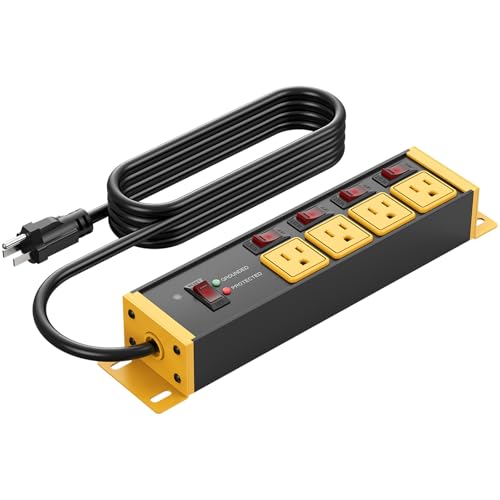
CCCEI 12 Gauge 6FT Yellow Surge Protector

CCCEI Magnetic 12 Gauge 6FT Orange Power Strip

CCCEI 8-Port 12 Gauge 6FT GFCI Strip
CCCEI 12 Gauge 6FT Yellow GFCI Power Strip
The Details Behind The Selections
Reaching a detached bench or the far corner of a two-car garage calls for more cord than a typical utility strip provides. The 50-foot run gives you room to reposition a workbench, welder outlet, or floor polisher while keeping the wall receptacle within reach.
Its 12-gauge conductor is the substantial part of the design, carrying current through a long cable with less resistance than lighter alternatives. Eight grounded outlets, a master switch, overload protection, and a three-prong plug make it more useful for sustained shop setups than a single-outlet extension.
The Value In It
- Long reach reduces awkward daisy-chaining across an open garage.
- Eight outlets support several bench tools from one central connection.
- 12-gauge wiring suits higher-draw equipment better than a lightweight cord.
- Yellow housing remains easy to identify around machinery and floor traffic.
Storage Is The Main Catch
- Fifty feet of cable needs careful coiling and dry storage to prevent avoidable twisting.
- The long housing is less convenient to carry than the six-foot alternatives here.
Quick Facts
Built With In Mind
Large-shop owners running stationary tools across a broad floor plan gain the most from this reach.
A Better Fit Elsewhere
CCCEI 8-Port 12 Gauge 6FT GFCI Strip suits tighter workbench layouts that need more outlets but less cable.
Unlike the long first option, this strip concentrates around a nearby work surface. Two USB-C connections and one USB-A port handle many phone, accessory, and low-power charging setups without requiring separate wall adapters, which is useful on a crowded electronics bench.
Four grounded AC outlets remain available for bench equipment. Individual outlet switches add practical control, while the master switch lets you disconnect the group during maintenance; for a compact garage, that combination can be more valuable than another ten feet of cable.
What It Does Well
- Mixed USB charging reduces adapter clutter around an electronics bench.
- Separate switches let you restart one device without disrupting the others.
- The compact six-foot lead stays manageable during routine repositioning.
Points To Note
- Four AC outlets are fewer than the eight-outlet designs in this list.
- Owners commonly coil the lead loosely after use to reduce connector strain.
Who It Suits Best
Bench technicians, hobbyists, and remote workers benefit most from a compact charging and power hub.
Swap It Out When
CCCEI 12 Gauge 6FT Yellow Surge Protector fits people needing separate AC switches and wall mounting rather than USB connections.
A fixed power station along a garage wall is where this option starts to make sense. Its wall-mount design removes the loose strip from the floor, while four separately controlled receptacles let each tool be switched independently during a busy project.
The power distribution uses 20-amp receptacle hardware, yet the attached plug and 15-amp, 1,875-watt rating set the practical limits. Unlike the GFCI models later in the list, this strip focuses on grounded service, individual control, and mounting access for industrial equipment.
Everyday Advantages
- Wall placement keeps frequently connected cables organized above the floor.
- Individual outlet controls simplify troubleshooting and routine shutdowns.
- Six feet offers useful placement flexibility around benches and cabinets.
Worth Noting
- Twenty-amp receptacles do not raise the strip’s listed 15-amp capacity.
- Professional installation matters when a permanent mounting position and wall receptacle are involved.
- It offers no GFCI control for moisture-prone areas.
Feature Snapshot
Made For
Home mechanics with a dedicated wall space and several frequently used tools gain the most practical control.
Another Choice May Suit
CCCEI Magnetic 12 Gauge 6FT Orange Power Strip suits mobile shop setups without a convenient mounting point.
A steel cabinet can become a usable power station without screws or a permanent bracket. The rear magnet holds this strip against compatible ferrous surfaces, giving you quick access at different heights around a metal workbench or cabinet.
That mobility separates it from CCCEI 12 Gauge 50FT Yellow Extension Cord and the wall-mounted third option. Four outlets, a master control, 12-gauge wiring, and a 15-amp rating still make it more substantial than a lightweight household strip, though magnetic placement depends on a clean, flat metal surface.
Bright Spots
- Magnetic mounting keeps outlets visible and within reach on steel storage.
- Orange housing is easy to spot around active shop equipment.
- The master switch provides one central operating point.
- Six-foot reach is practical for equipment positioned near the mounting surface.
Trade Offs
- The mount will not hold on wood, plastic, drywall, or painted surfaces that prevent firm magnetic contact.
- Moving a loaded strip can pull attached plugs sideways, so the cords need gentle handling.
Technical Notes
The Right Fit
Mechanics working around clean steel cabinets and benches benefit from portable outlet access without wall installation.
Where Another Pick Shines
CCCEI 12 Gauge 6FT Yellow Surge Protector serves fixed shops where a drilled wall position is preferable to magnetic placement.
Eight outlets turn a single six-foot strip into a compact distribution point for chargers, lights, bench tools, and small appliances. That outlet density is especially helpful in a crowded garage where several devices share one nearby wall receptacle.
A GFCI, or ground-fault circuit interrupter, monitors the imbalance between outgoing and returning current and interrupts power in certain fault conditions. It adds a layer of response relevant around damp locations, while overload and grounding protection provide additional electrical safeguards.
Everyday Perks
- Eight outlets reduce the need for several adapters stacked at one bench.
- GFCI support suits garages where moisture or damp floors can occur.
- Twenty-amp switching provides central control for the connected group.
Practical Considerations
- The large housing needs enough clear space around the outlet faces.
- Owners commonly keep the strip elevated and away from standing water or damp storage areas.
- It does not provide separate switches for each outlet.
Feature Card
Who Will Love This
Dedicated workshop and hobby areas with many low-to-moderate-draw devices benefit from the eight-outlet layout.
Reach For A Different Pick When
CCCEI 12 Gauge 50FT Yellow Extension Cord suits open floor plans where distance matters more than outlet concentration.
The last option occupies the useful middle ground between the eight-outlet model and the more specialized strips. Four individually switched receptacles give you direct control over chargers, task lights, and bench equipment, while the six-foot lead remains easy to reposition.
GFCI protection makes it more relevant to garages with changing moisture conditions, and the yellow housing stays conspicuous around a work area. Its listed 15-amp capacity still governs the complete strip, so the individual 20-amp switches should not be read as permission to exceed the equipment rating.
The Case For It
- Individual switches reduce unnecessary shutdowns across connected tools.
- GFCI monitoring adds useful response for damp garage environments.
- The six-foot cable balances reach with easier storage.
- Overload and grounding protection support organized bench use.
Smaller Limitations
- Four outlets are less generous than the eight-port alternative.
- For a large detached shop, the short lead may stop well short of the work area.
Core Details
Built With In Mind
General garage users managing a moderate group of bench devices get the most balanced feature set.
Where It May Fall Short
CCCEI 8-Port 12 Gauge 6FT GFCI Strip better serves dense charging areas that need more receptacle positions.
Choosing Cords That Fit Your Garage
Match Length Before Outlet Count
Start with the distance from the wall receptacle to your actual work area. A 50-foot cable solves reach problems across an open garage, but shorter cords are easier to route, store, and keep clear of vehicle traffic. Measure the complete path rather than estimating by room width.
Understand Wire Gauge And Capacity
A 12-gauge conductor is intended for higher-current equipment than the lighter cords commonly used around homes. Its lower resistance can also make it more appropriate for long runs, though connected tools and wall-circuit limits still control real-world use. The listed 15-amp, 1,875-watt rating matters more than marketing language.
Choose Controls That Match Your Routine
Individual outlet switches save time by isolating one tool without shutting down the entire strip. A master switch is useful for grouped equipment, while USB ports only add value when you regularly charge compatible electronics from the same location. Match those features to real devices rather than paying for unused capacity.
Placement Matters More Than You Expect
Wall mounting keeps a permanent power hub visible and organized, while a magnetic back suits clean steel cabinets. In a damp work area, GFCI control deserves consideration, and every attached lead should remain dry and clear of pinch points.
Garage Power Details That Matter
Common Shopping Slip Ups
The easiest mistake is choosing length before checking the route to your tools. Another is treating a 20-amp receptacle as permission for a 20-amp load, even though the complete strip and wall circuit carry separate limits. Long cords also need dry, orderly storage to prevent connector and jacket damage.
What The Higher Tier Buys
Added protection features, magnetic or wall mounting, USB connections, and more independent controls can remove practical friction in a busy shop. Those extras matter most where cables cross traffic or many devices share one area. A simple compact strip remains more sensible for a single nearby workbench.
Frequently Asked Questions
Is 12-Gauge Wire Suitable For Garage Tools?
Yes, 12-gauge wire is a practical choice for many higher-draw garage tools. Device requirements and wall-circuit limits still determine safe loading.
Which Length Is Most Practical?
A six-foot strip fits a nearby bench or cabinet. A 50-foot cord serves larger rooms where the receptacle sits far from the working area.
Do Twenty-Amp Switches Increase Total Capacity?
No. The complete power strip still operates within its listed rating. Individual switches control outlets without changing the assembly’s total capacity.
Is GFCI Control Useful In A Garage?
It can be useful where moisture or damp floors may occur. Placement, wiring, and local electrical requirements still deserve careful attention.
Can A Magnetic Strip Attach To Any Surface?
It requires a firm magnetic connection, typically clean exposed steel. Paint, dust, plastic, and drywall can prevent secure attachment.
