
A laser level turns alignment from guesswork into a repeatable reference line, whether you are hanging a gallery wall, setting tile, checking cabinet height, or laying out a renovation. The right model depends on coverage, beam color, mounting needs, and how much control you want at the job site. These six options cover compact home projects, full-room layouts, and professional construction work.
The Picks In Brief

Huepar W04CG 4×360 Bluetooth Laser Level

Fanttik D2 Pocket Green Laser Level

ENRIPRT 16-Line 4×360 Green Laser Level
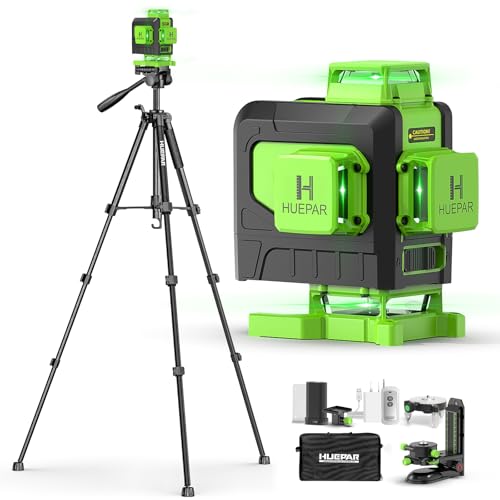
Huepar 4×360 Laser Level with 60-Inch Tripod

Johnson 40-6184 Magnetic Torpedo Laser Level

Huepar U011G Green Laser Level with Tripod
More On The Choices That Made The List
The W04CG is built for layout work that outgrows a simple cross-line tool. Its 4×360-degree projection spreads horizontal and vertical lines across a room, while the motorized rotating base and Bluetooth remote reduce repeated movement around corners. The large LCD screen is useful for reading settings from a ladder or across a renovation area.
Contractors and remodelers gain the most from its remote-controlled setup, especially during wall, ceiling, and partition work. The honest read is that this is more equipment than a quick picture-hanging task needs, but it fits professionals who regularly create reference planes across multiple surfaces.
Key Advantages
- Full 4×360-degree coverage supports walls, floors, ceilings, and partitions.
- Bluetooth control lets you adjust the unit without walking back to its base.
- Sixteen green lines make intersections easier to follow across a work area.
- The LCD screen keeps operating information visible during setup.
Points To Note
- The 360-degree feature set is unnecessary for small decor projects.
- Remote and motorized functions add more controls than a basic cross-line model needs.
- Keep the glass and housing clean, since dust on the aperture can reduce visibility.
Made For
This model suits contractors, remodelers, and advanced DIYers handling large rooms, multiple wall planes, and repeated alignment tasks.
A Better Fit Elsewhere
For quick indoor mounting, the Huepar U011G is simpler, while the Johnson 40-6184 fits narrow spaces and beam-based guidance.
The Fanttik D2 takes a different approach from the full-room models. Its pocket format makes it easy to carry between rooms, hang pictures, set shelves, and check cabinet or mirror placement without setting up a large tripod. Green light is easier to follow than red in many bright indoor spaces.
Renters, apartment residents, and occasional home improvers will appreciate the rechargeable 2200 mAh battery, which provides up to 10 hours of continuous operation. The compact size is the real advantage, though the tool offers less coverage than the Huepar W04CG for broad construction layouts.
Where It Helps
- Pocket dimensions suit small rooms, furniture installation, and gallery walls.
- The rechargeable battery removes the need for disposable cells during home projects.
- Green light offers clear visibility for indoor marking and alignment.
Small Caveats
- Its compact format is less suitable for large floor and ceiling coverage.
- The 10-hour runtime is a maximum usage figure and depends on operating conditions.
- Charging the unit before a renovation session avoids a mid-project power interruption.
Feature Snapshot
Right Fit For
This model is well suited to apartment living, picture hanging, shelving, mirrors, and other portable indoor layout tasks.
Where A Sibling Pick Shines
Choose the ENRIPRT 16-Line model instead for construction work needing wider room coverage and two included batteries.
The ENRIPRT model expands the working area with 16 green lines and 4×360-degree coverage, so you can establish vertical and horizontal references around walls, floors, and ceilings. It self-levels within ±4 degrees, which helps on uneven work surfaces, while manual mode supports angled lines for stairs and roof layouts.
Two rechargeable batteries and a magnetic bracket make it practical for extended renovation sessions. Compared with the Fanttik D2, the ENRIPRT is less pocketable but much more capable for tile, partitions, and larger room setups; depending on your lighting, the green lines may be harder to follow in very bright spaces.
What It Does Well
- Sixteen lines provide multiple vertical and horizontal reference points.
- Self-leveling reduces manual adjustment on floors within the stated tilt range.
- The magnetic bracket supports hands-free placement on suitable metal surfaces.
- Two batteries help preserve working time during longer projects.
Less-Strong Areas
- The broad feature set is excessive for one-wall or single-picture projects.
- Manual angled-line mode requires care on stairs and roof layouts.
- Store batteries separately from the tool when they are not in use to avoid accidental contact.
Technical Highlights
Built With In Mind
This level fits contractors, remodelers, and serious home renovators who need broad coverage across active construction spaces.
Reach For A Different Pick When
Use the compact Fanttik D2 for portable indoor decor, and choose the Huepar 60-inch tripod set for a ready-made support system.
This Huepar package pairs 4×360-degree green cross-line coverage with a 60-inch tripod, reducing the setup decisions involved in larger projects. The two horizontal and two vertical line sets help with tile, ceiling grids, wall alignment, and partition work. An outdoor pulse mode is included for locations where increased beam visibility matters.
It is a sensible middle ground between the portable Fanttik D2 and the more control-heavy Huepar W04CG. The stated accuracy of ±1/16 inch at 16.5 feet supports careful layout work, while the tripod helps you establish a level reference at useful working heights.
Bright Spots
- Complete 4×360 coverage supports full-room layout and installation work.
- The included tripod makes elevated ceiling and wall references easier to position.
- Pulse mode offers an outdoor visibility option for larger work areas.
- Green lines are easier to follow than red lines in many bright indoor settings.
- One package covers both the laser unit and its main support.
A Few Limitations
- The 60-inch tripod may be less useful in very tight rooms.
- Outdoor visibility can change with sunlight and surface contrast.
- Clean the tripod feet and laser aperture before storage to reduce dust transfer.
Feature Card
Who Will Love This
This setup suits home renovators, tile installers, and decorators who want full-room coverage plus a tripod in one package.
Another Choice May Suit
Choose the Johnson 40-6184 instead for beam guidance and magnetic placement in confined spaces.
The Johnson 40-6184 is a torpedo-style tool, so its narrow body fits into tighter working areas where a larger self-leveling unit can be awkward. The magnetic housing attaches to steel or other suitable ferrous surfaces, helping with conduit, framing, cabinets, and installed metalwork.
Three beams at right angles plus four vials give you both line guidance and conventional leveling references. Its ±1/8-inch-per-50-feet accuracy and 100-foot beam distance suit routine installation checks, although it does not create the 16-line room coverage of the Huepar or ENRIPRT models.
Good Reasons To Consider
- Compact torpedo form reaches narrow gaps and confined framing areas.
- Magnetic placement supports hands-free alignment around metal surfaces.
- Three perpendicular beams help check level, plumb, and 90-degree alignment.
- Four vials provide familiar visual references for common setup checks.
Trade Offs To Consider
- Beam visibility becomes less convenient in bright, open areas.
- Magnetic use depends on finding a clean, stable metal mounting point.
- Traditional vials require careful reading during setup, especially in a moving work area.
Core Details
The Right Fit
This model fits installers, mechanics, and DIYers who need a portable line reference in tight spaces or around metal surfaces.
Look Elsewhere When
Use the Fanttik D2 for a compact green cross line, or choose the Huepar U011G for tripod-supported indoor layout.
The U011G focuses on the common home-layout tasks that benefit from a horizontal and vertical reference. It works well for gallery walls, shelves, cabinets, mirrors, curtain rods, and tile starts, with green lines that remain visible across ordinary indoor rooms. The 60-inch tripod gives you a stable elevated position without requiring a separate support.
Its ±1/16-inch accuracy at 16.5 feet is a practical fit for measured interior projects, though it offers less coverage than the Huepar 4×360 package. For a large open room, the 16-line ENRIPRT may make more sense; for a small apartment task, the U011G feels more appropriately focused.
A Few Highlights
- Green cross lines support common indoor mounting and layout tasks.
- The included tripod helps position the reference at a comfortable working height.
- Accuracy of ±1/16 inch at 16.5 feet suits measured interior work.
Possible Compromises
- Two-line coverage is less flexible than the 360-degree models.
- The tripod takes more space than the pocket Fanttik D2.
- Keep the tripod locked and the laser housing dry during storage.
Quick Facts
Who It Suits Best
This model suits home decorators, renters, and DIYers handling shelves, artwork, cabinets, mirrors, and interior tile layouts.
Not Your Match When
Choose the ENRIPRT 16-Line model for broad construction coverage and multiple vertical references.
Choosing Laser Levels by Coverage, Visibility, and Support
Coverage is the first distinction. A cross-line level gives you a horizontal and vertical reference, while a 4×360 model spreads lines across multiple room planes. Choose full coverage for tile, ceilings, walls, partitions, or large renovation areas; a simpler cross-line level is usually easier to manage for one shelf or a gallery wall.
Beam color also affects visibility. Green light is often easier to follow in bright indoor rooms, while red remains a familiar alternative. Outdoor work adds a different concern, so pulse mode, surface contrast, and the distance between the tool and your reference point matter more than the color alone.
A tripod can make a moderate laser more useful. It raises the unit for ceiling work and helps keep the reference stable, but it also occupies floor space. Magnetic brackets and torpedo bodies serve a different purpose, especially around framing, conduit, and metal surfaces. Match the mounting style to the job site before choosing extra line coverage.
Layout Details That Change the Choice
Pitfalls Shoppers Hit
A common mistake is choosing more coverage than the task needs. Another is ignoring room size, mounting height, and whether the tool will be used indoors or outdoors. Check the stated accuracy and working distance against the actual layout, then make sure the included stand or bracket fits your work surface.
What Separates Premium From Basic
Higher-tier tools tend to add multiple line sets, self-leveling behavior, remote control, and larger support systems. Those extras help during frequent or complex work, while a compact model can be more convenient for occasional indoor mounting. The useful upgrade is the feature that removes a recurring setup problem, not simply the largest specification list.
Frequently Asked Questions for Laser Levels
What type of laser level is best for hanging pictures?
A cross-line level is usually enough for aligning frames, shelves, and wall marks. A 360-degree model helps more with full-room alignment and repeated references.
Are green laser lines brighter than red lines?
Green lines can appear easier to see in many bright indoor conditions. Actual visibility also depends on room lighting, distance, and the surface receiving the beam.
Do laser levels need a tripod?
A tripod helps with ceiling work and keeps the reference at a consistent height. Compact magnetic or pocket-style tools can be useful without one for smaller projects.
Can a laser level replace a traditional level?
A laser level provides a fast reference line or plane across a room. A traditional level or torpedo level can still be useful for short checks and tight spaces.
How accurate should a laser level be for home projects?
Accuracy matters more when marks drive cabinet, tile, or shelf installation. For simple picture hanging, a basic cross-line reference is often sufficient.
