
Garage temperature checks become much easier when you can inspect an engine, exhaust component, outlet, vent, or hot motor from a safe distance. These infrared thermometers suit DIY maintenance, automotive work, HVAC diagnostics, and general household inspections where immediate surface-temperature readings save time. The main differences here are temperature range, laser targeting, rechargeability, and the extra heat capacity needed for demanding workshop tasks.
The Essentials At A Glance

FKM Infrared Thermometer Gun -58°F~986°F
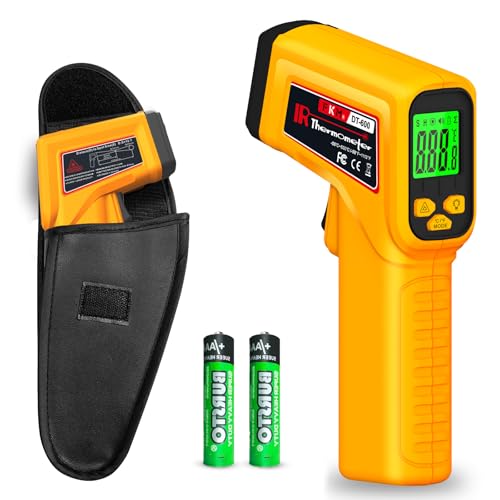
FKM 13-Point Laser Thermometer -58°F~1112°F

FKM Rechargeable Infrared Thermometer, 13-Point Laser

FKM 13-Point Laser Thermometer -58°F~1112°F

FKM Non-Contact Thermometer -58°F~1112°F

FKM Non-Contact Thermometer -58°F~1112°F
A Closer Look At Each Pick
The FKM Infrared Thermometer Gun suits routine checks around a home garage, from radiator areas to appliance vents and electrical fixtures. Its single laser gives you a clear aiming point, which makes close surface checks less confusing than a scattered multi-point pattern.
For everyday vehicle work, the stated 986°F upper limit covers the temperatures you’re most likely to encounter. The lower 986°F ceiling becomes relevant sooner than the 1,112°F and 1,472°F limits offered elsewhere in this list, so heavy exhaust or furnace work gives you less margin.
The Helpful Details
- Single-laser targeting makes it practical for close, deliberate readings.
- Adjustable emissivity lets you account for how different surfaces emit infrared energy.
- The -58°F to 986°F range suits radiators, engines, and household equipment.
- Non-contact operation reduces proximity to hot vehicle and workshop components.
Minor Gripes
- The 12:1 distance-to-spot ratio calls for careful aiming at a distance.
- Keep the lens clean, since dust and oil can distort practical readings.
Feature Snapshot
Made For
You benefit most from this pick during routine home and vehicle maintenance where a simple laser target and moderate upper range are enough.
Another Choice May Suit
Choose the FKM Rechargeable Infrared Thermometer, 13-Point Laser for mobile work needing cordless convenience and a higher temperature ceiling.
Thirteen laser points make this FKM model easier to place on compact engine parts, outlet faces, and HVAC vents. You can confirm that the entire laser pattern lands on the intended surface, reducing the chance of accidentally combining readings from two temperature zones.
Compared with the first FKM pick, it raises the maximum to 1,112°F while retaining adjustable emissivity. For most garage inspections that added range is useful without making the tool noticeably more complicated, although a larger target can still require close positioning.
Where It Excels
- Multi-point targeting helps you place the reading on smaller components.
- The extended range handles hotter engines, vents, and workshop equipment.
- Emissivity adjustment supports checks on surfaces with different finishes.
- Fast non-contact readings suit repeat inspections without touching the component.
Points To Note
- Thirteen points create more visual information than a single-dot laser.
- Its 1,112°F maximum remains below the rechargeable model’s range.
- Store it away from moisture and heavy workshop knocks.
Key Specs
Who It Suits Best
Experienced DIYers benefit from the clearer target pattern during repeated checks of compact automotive and HVAC parts.
Swap It Out When
The FKM Infrared Thermometer Gun -58°F~986°F serves you better when a single aiming point and simpler display matter more.
Rechargeable power and a 13-point laser pattern give this FKM model a distinct advantage for mobile diagnostics. You can move between a vehicle, HVAC cabinet, and storage area without staying near a wall outlet.
Its stated range reaches 1,472°F, the highest ceiling here, which matters for hotter exhaust components and furnace-related work. That broader range does not replace correct surface settings, so the adjustable emissivity still deserves attention during each inspection.
Why It Works Well
- Rechargeable operation suits work away from a convenient outlet.
- Thirteen targeting points help you center readings on smaller areas.
- The 1,472°F maximum provides the most heat headroom in this group.
- Non-contact use keeps your hand away from hot components.
Honest Caveats
- A rechargeable tool depends on battery availability and charging time.
- Confirm the correct emissivity setting for bare metal and reflective finishes.
- The larger laser pattern may feel busy on a very small part.
- Charging contacts can collect workshop dust and need occasional cleaning.
Built With In Mind
You’ll get the most from this pick as a mobile technician or serious DIYer who repeatedly works on high-heat automotive and HVAC equipment.
Look Elsewhere When
For a stationary workbench and simpler everyday checks, the FKM 13-Point Laser Thermometer -58°F~1112°F offers the same targeting style with a lower maximum.
The FKM 13-Point Laser Thermometer combines a -58°F to 1,112°F range with adjustable emissivity, making it a practical all-rounder for mixed garage surfaces. You can check an engine, painted panel, vent, or metal fitting without changing tools.
Unlike the rechargeable pick, this version centers the appeal on conventional operation and surface settings. The source data gives you less detail about power and charging, so treat the rechargeable model as the stronger fit specifically for mobile use.
Key Advantages
- Adjustable emissivity helps match readings to different surface finishes.
- Thirteen laser points make small targets easier to locate.
- Non-contact readings reduce touch and handling during inspections.
- The broad range covers common automotive and household applications.
Less-Strong Areas
- It lacks the higher heat ceiling of the rechargeable FKM model.
- The multi-point pattern requires a steady hand on curved surfaces.
- Keep the sensor away from direct sunlight and moisture.
Technical Highlights
The Right Fit
This pick suits home mechanics who alternate between automotive, HVAC, and household inspections in one compact garage tool.
Where A Sibling Pick Shines
Pick the FKM Rechargeable Infrared Thermometer, 13-Point Laser when you need cordless operation and substantially more upper-range capacity.
Fast readings make the FKM Non-Contact Thermometer useful beyond the garage, including cooking surfaces, heating equipment, and general temperature checks. The stated 0.5-second response helps you move through a diagnostic routine without waiting on each result.
The -58°F to 1,112°F range gives you room for most household and automotive surfaces. Compared with the first pick, it offers more upper-end capacity, though its useful advantage is response speed rather than rechargeability or a particularly distinctive laser pattern.
Benefits That Matter
- 0.5-second readings suit quick comparisons across several components.
- Non-contact measurement helps with hot oils, HVAC parts, and machinery.
- The wide temperature span covers both cold and hot garage surfaces.
- The same tool can assist with cooking and household temperature checks.
Practical Considerations
- Fast response does not remove the need for correct emissivity settings.
- Use a protective case and keep the lens clean in dusty spaces.
Made For
You benefit most from this option when you want one responsive thermometer for garage, kitchen, and household maintenance.
A Better Fit Elsewhere
The FKM 13-Point Laser Thermometer -58°F~1112°F gives you a clearer multi-point target for small components and reflective workshop surfaces.
This FKM model brings a 13-point laser pattern and adjustable emissivity into a conventional non-contact thermometer, giving you more control over demanding garage checks. That makes it a natural fit for technicians or serious DIYers who compare several materials rather than one simple surface.
The -58°F to 1,112°F range covers many automotive, heating, and ventilation scenarios. You’ll get more benefit from the surface controls than someone making occasional one-off checks, especially on shiny metal where incorrect settings can distort the result.
Well-Handled Touches
- Thirteen points help you place the measurement on small parts.
- Emissivity adjustment supports differing surface materials.
- Fast non-contact operation reduces waiting during comparisons.
- The broad range suits vehicle and HVAC maintenance.
Trade-Offs To Consider
- It offers less maximum heat capacity than the rechargeable model.
- The controls may feel excessive for casual household checks.
- Protect the sensor from impacts and store the lens cap securely.
Feature Facts
Who Should Grab It
You’ll find this pick most useful for repeated diagnostics across metal, painted, and mixed-finish garage components.
Reach For A Different Pick When
Choose the FKM Infrared Thermometer Gun -58°F~986°F for routine maintenance that favors one easy-to-follow laser point.
What Matters Most Before You Choose
Start with the temperature range your work actually demands. Radiators, engines, ovens, and household vents may fit within a 986°F ceiling, while furnace and exhaust work can justify 1,112°F or the rechargeable model’s 1,472°F maximum.
Laser configuration changes the way you work. A single point is straightforward for close inspections, while 13 points help you center a reading on a small target or confirm the measured area on a larger surface.
Emissivity is the setting that tells the instrument how a material emits infrared energy. Set it according to the surface finish where possible, because bare metal, paint, and textured coatings do not all behave the same way.
Finally, consider movement and power. A rechargeable model makes sense for frequent work away from an outlet. A conventional thermometer may suit a fixed bench, while its sensor lens and casing should be kept clean and protected from workshop moisture.
Common Sense For Garage Temperature Tools
Mistakes Worth Dodging
A larger number of laser points does not automatically produce a better reading for every surface. You can also lose accuracy by using the wrong emissivity setting, ignoring surface reflections, or holding the tool too far from a small component.
What Separates Premium From Basic
The higher-range rechargeable model spends its premium position on more heat headroom and cordless mobility. Those features matter for repeated automotive or furnace work, while basic garage checks may not require either upgrade.
Frequently Asked Questions
How do you aim an infrared thermometer at a small engine part?
Center the laser pattern on the intended surface and keep the sensor outside the direct heat. A closer reading reduces the target area, which helps with bolts, outlets, and narrow components.
What does adjustable emissivity do?
It tells the thermometer how a surface emits infrared energy. Correctly matching the setting improves consistency across different materials, especially paint and bare metal.
Can infrared thermometers measure cold garage temperatures?
Yes, models with a -58°F lower limit can measure well below typical indoor conditions. Accuracy still depends on correct aiming, surface settings, and environmental conditions.
Is a 13-point laser better than a single laser?
A 13-point pattern shows the measurement area more clearly, which helps with small or uneven targets. A single laser is easier to interpret during close, straightforward checks.
Which FKM model handles the highest temperatures?
The FKM Rechargeable Infrared Thermometer, 13-Point Laser has the highest stated maximum at 1,472°F. It is the strongest fit for high-heat mobile diagnostics in this group.
