
A damp, poorly ventilated basement can hide cold drafts, uneven heating, and temperature swings behind stored boxes or finished walls. Infrared thermometers help you scan those areas quickly without touching machinery, ductwork, pipes, or damp surfaces. They suit homeowners diagnosing comfort issues, landlords checking older properties, and maintenance staff comparing HVAC equipment across a large space.
Choose by temperature range, target size, emissivity control, power source, and measurement distance. A broader range has limited value in many basements, while precise laser targeting matters more when pipes or ducts appear small from a safe working distance.
Your Options, Compared

FKM Infrared Thermometer Gun -58°F~986°F
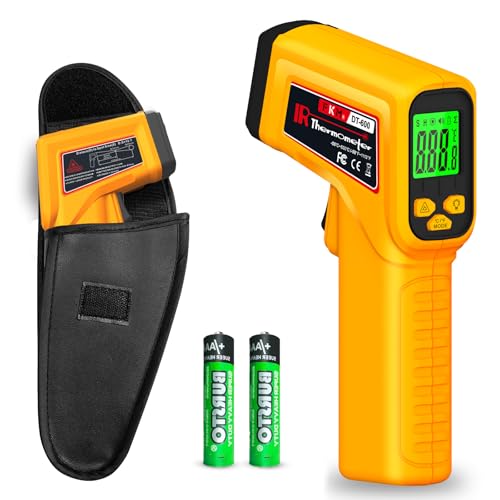
FKM Infrared Thermometer Gun 13-Point Laser -58°F~1112°F

FKM Rechargeable Infrared Thermometer Gun 13-Point Laser

FKM Infrared Thermometer Gun -58°F~1112°F

FKM Infrared Thermometer Gun -58°F~1112°F

FKM Non Contact Laser Thermometer Gun -58°F~1112°F
The Details Behind The Selections
The FKM Infrared Thermometer Gun -58°F~986°F focuses on the range most homeowners need for finished basements, storage areas, and mechanical rooms. Its -58°F lower limit supports cold-surface checks, while the 986°F ceiling leaves ample headroom for ordinary HVAC and utility work. The single laser makes it straightforward to compare nearby walls, floors, and pipe sections.
Compared with the 13-point models later in this list, this model favors a simpler targeting pattern. That may be preferable during a quick sweep of a large basement, particularly when you are working around boxes, ceiling joists, and exposed ducts. You still get adjustable emissivity, though correct surface settings remain important.
The Case For It
- Wide 986°F ceiling supports routine hot-surface investigations.
- -58°F lower limit suits cool basements and nearby ducts.
- Single-laser aiming reduces visual clutter during broad scans.
- Adjustable emissivity helps accommodate different household surfaces.
Things To Consider
- Single-point aiming is less helpful for tiny, distant components than the 13-point models.
- Glossy metal and painted surfaces can produce misleading readings with an incorrect emissivity setting.
- Keep the lens clean in damp or dusty basements so dust does not distort the measurement field.
Quick Facts
Made For Routine Home Checks
You benefit most from this model during basic scans of finished basements, storage rooms, and accessible HVAC components.
A Better Fit Elsewhere
The FKM Infrared Thermometer Gun 13-Point Laser -58°F~1112°F suits you better when precise aiming on small ducts or distant pipes matters more.
Thirteen laser points give this FKM model a more deliberate aim than the single-laser option. Emissivity means how efficiently a surface emits infrared energy, and adjusting it can improve consistency across painted drywall, wood, masonry, and metal. In your basement, that control becomes useful when one thermal scan crosses several different materials.
The 12:1 distance-to-spot ratio keeps the marked area controlled, although precision still depends on distance and surface condition. Compared with the first model, this version adds multi-point targeting and more upper-range headroom. It fits a maintenance-minded homeowner comparing small pipe runs or inspecting equipment from a ladder or open floor area.
The Practical Payoff
- Thirteen points make small components easier to identify from across a room.
- 1,112°F ceiling covers higher-temperature HVAC and utility checks.
- Adjustable emissivity supports comparisons across mixed basement materials.
- Broad range handles both cold drafts and hot equipment.
- Multi-point pattern reduces the need to reposition on narrow targets.
Small Caveats
- The multi-laser pattern can look crowded on a large nearby wall, so hold the tool at a sensible distance.
- Reflective metal remains difficult because its apparent temperature depends heavily on emissivity and reflected radiation.
- Store the unit in a dry case between basement visits to limit exposure to moisture and dust.
Feature Snapshot
Built With HVAC Work In Mind
You gain the most from this model when diagnosing small ducts, pipe joints, vents, and mixed-material walls.
Consider Something Else When
The FKM Rechargeable Infrared Thermometer Gun 13-Point Laser offers a higher ceiling and rechargeable operation for frequent maintenance work.
Rechargeable operation separates this FKM DT-800 model from the pack-style choices surrounding it. You avoid recurring disposable-cell replacements, which suits property managers, maintenance technicians, and homeowners who repeatedly scan mechanical rooms. Its 13-point laser pattern also provides a defined target on compact equipment parts.
The -58°F to 1,472°F span handles cold basement surfaces and substantially hotter equipment. The 12:1 distance-to-spot ratio and adjustable emissivity support controlled scans, though you still need to match the setting to each material. Compared with the FKM Infrared Thermometer Gun 13-Point Laser -58°F~1112°F, it adds reach and rechargeable convenience rather than a fundamentally different measurement approach.
Useful Strengths
- Rechargeable battery suits repeated maintenance rounds.
- 1,472°F ceiling expands coverage for hot utility equipment.
- Thirteen laser points help frame small components.
- Adjustable emissivity supports mixed-material scans.
Worth Bearing In Mind
- Charging adds a management step that disposable-cell models do not require.
- The high upper limit is less relevant for ordinary residential comfort checks.
- Protection-plan language on the listing does not replace careful charging and storage habits.
Who Should Grab It
You benefit most from rechargeable convenience and extended range when performing frequent basement or utility inspections.
Another Choice May Suit
The FKM Infrared Thermometer Gun -58°F~986°F is simpler for occasional scans where maximum temperature reach adds little value.
This FKM model balances a broad -58°F to 1,112°F range with 13-point laser targeting. That combination works well for comparing cold perimeter walls, warm duct sections, and small mechanical fittings without changing instruments. It is a sensible general-purpose option for basements that combine residential storage with utility equipment.
Adjustable emissivity matters because concrete, wood, painted metal, and unfinished surfaces reflect infrared energy differently. Setting the control more carefully helps your scans tell you more than the temperature number alone. Compared with the FKM Infrared Thermometer Gun -58°F~986°F, this model gives you finer visual targeting and a hotter upper limit without the rechargeable complexity of the DT-800.
Positive Points
- Thirteen points clarify small components during remote scans.
- Temperature span suits both comfort and equipment checks.
- Emissivity adjustment supports several common basement materials.
Less-Strong Areas
- Surface finish can still distort readings when emissivity is set too low.
- The laser marks the target, but the instrument does not replace contact diagnostics for every electrical or mechanical fault.
Core Details
The Right Fit
You suit this model when you want flexible range, multi-point aiming, and straightforward mixed-surface scanning.
Reach For A Different Pick When
The FKM Rechargeable Infrared Thermometer Gun 13-Point Laser fits frequent technicians better because it removes disposable battery changes.
Quick response suits spot checks of HVAC equipment, pipes, and household surfaces in a finished basement. The -58°F to 1,112°F span covers both cold drafts and hotter mechanical components, while non-contact measurement keeps your hands away from active equipment. It also helps during cooking and vehicle work outside the basement, provided you approach reflective materials carefully.
Compared with the neighboring 13-point FKM choices, this model emphasizes fast setup and straightforward scanning rather than elaborate targeting detail. The source lists a 0.5-second response time and adjustable emissivity, both helpful during repeated inspections. In practice, you may find the single-point presentation more comfortable for scanning a large wall or locating a broad temperature difference.
Everyday Perks
- Fast response supports quick household troubleshooting.
- Non-contact use keeps you away from hot or moving equipment.
- Broad range also serves cooking and vehicle tasks.
- Emissivity adjustment improves consistency across different finishes.
Details To Watch
- Fast readings cannot account for unseen moisture inside walls or floors.
- Shiny metal and very small distant targets remain difficult to assess accurately.
- Wipe the lens regularly around dusty ducts and stored materials.
Who Will Love This
You benefit most from quick scans of accessible pipes, ducts, walls, appliances, and household equipment.
Where A Sibling Pick Shines
The FKM Non Contact Laser Thermometer Gun -58°F~1112°F offers a clearer fit for distant, compact components through its 13-point pattern.
Controlled 13-point targeting makes this FKM model attractive for detailed basement comparisons. You can frame small pipe joints, vent outlets, and equipment housings more consistently than a single-laser tool, particularly from across a finished room. Its -58°F to 1,112°F range covers the broad temperature conditions found around residential mechanical systems.
Adjustable emissivity from 0.1 to 1.0 gives you control over surface finish, though glossy metal still calls for caution. Compared with the FKM Infrared Thermometer Gun -58°F~986°F, this model adds multi-point aiming and more upper-range reach. The honest fit is a compact diagnostic aid, not a complete building inspection system, so pair it with airflow, moisture, and electrical checks where needed.
Reasons It Performs
- Thirteen-point targeting narrows in on small mechanical components.
- Wide range supports cold and hot basement comparisons.
- Non-contact scanning improves access around active equipment.
- Emissivity control accommodates different material finishes.
- Fast measurement supports repeated point-by-point checks.
Points To Note
- Laser placement does not verify the temperature of everything inside that marked area.
- Reflective metal can distort readings regardless of careful setup.
Feature Facts
Whose Shelf It Belongs On
You benefit most from this model when detailed HVAC, pipe, and duct comparisons are routine parts of basement work.
Swap It Out When
The FKM Rechargeable Infrared Thermometer Gun 13-Point Laser fits mobile maintenance professionals better who prioritize extended range and rechargeable operation.
What Matters Most For Basement Temperature Checks
Start With Target Size
Distance-to-spot ratio describes how the measured area grows as you move away from a surface. A 12:1 ratio keeps scans reasonably controlled in a basement, but even that becomes a broad zone across a large room. Stand closer to small pipe joints or position yourself with a clear line of sight.
Emissivity Changes The Reading
Emissivity describes how a surface emits infrared energy, and different finishes behave differently. Bare metal, painted surfaces, concrete, wood, and fabric may require different settings. You can improve consistency by learning the material values and using comparison shots from the same distance and angle.
Match The Range To Your Work
A -58°F lower limit covers cold rooms, while the upper limits across these models reach 986°F, 1,112°F, or 1,472°F. Most residential comfort checks need only a modest high-end range, but technicians may appreciate extra reach. Choose the wider span only where hot equipment genuinely requires it.
Consider Power And Storage
Disposable cells keep ownership simple, while a rechargeable model suits repeated maintenance rounds. Basement storage also matters: humidity and dust can affect a tool kept in an unprotected cabinet. Use a dry storage location and keep the lens clean for dependable targeting.
Basement Thermometer Decisions Made Clear
Mistakes Worth Dodging
Aim at the wrong surface or distance, then treat the result as a diagnosis. Different materials need suitable emissivity settings, and small targets become much larger farther away. Clean the lens, hold a consistent angle, and compare like surfaces before drawing conclusions.
What Separates These Models
The FKM DT-800 adds rechargeable operation and a 1,472°F ceiling, making it more relevant for frequent maintenance work. The other 13-point choices focus on the same -58°F to 1,112°F span, so simpler requirements may make their ownership more straightforward. Pay for the features your routine work actually uses.
Frequently Asked Questions
Can infrared thermometers detect moisture in a basement?
No. They measure surface temperature, so differences may suggest dampness but cannot confirm moisture inside materials. Moisture meters and inspections provide additional evidence.
What temperature range is useful for a basement?
A -58°F lower limit handles cold rooms, while readings above 1,000°F mainly benefit hot-equipment checks. Most comfort investigations need less range and rely more on comparing nearby surfaces.
Is a 13-point laser better than a single laser?
Multi-point targeting helps frame small components from a distance. A single laser may feel simpler for broad scans of walls, floors, and large ducts.
Does emissivity affect basement readings?
Yes. Concrete, wood, drywall, fabric, and metal have different infrared behavior. Incorrect settings can make similar surfaces produce noticeably different readings.
Can you use these thermometers on electrical equipment?
You can scan accessible surfaces without touching them, but you still need safe procedures and qualified expertise. Thermal readings do not replace electrical testing or a qualified inspection.
