
Surge protection and signal isolation solve different parts of the same electrical reliability problem. A home office may need outlet distribution, while a control cabinet, network rack, or industrial system needs protection at the signal, Ethernet, or mounting level. The six options below cover those distinct jobs, so you can match the hardware to your equipment, wiring, and available space rather than treating every electrical accessory as interchangeable.
How The Shortlist Stacks Up

WTH-SC/mA/11 Magnetic Signal Isolator, DIN Rail, 24V

WTH-SC/mA/11G 4-20mA Signal Isolator with Surge Protection

DIN Rail Mounting Bracket, 17-Inch Slotted Aluminum Alloy

WTH-SG/RJ45 Gigabit Ethernet PoE DIN-Rail Surge Protector
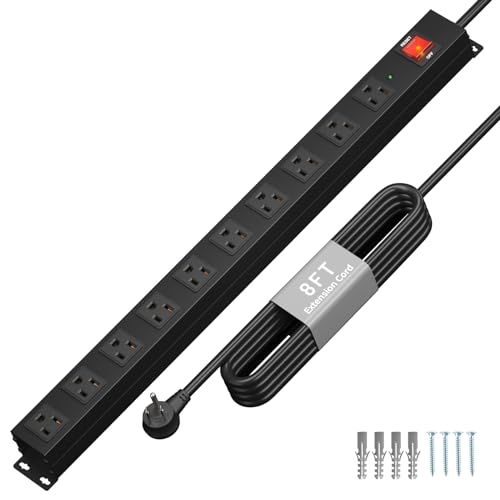
KF 10-Outlet Heavy Duty Power Strip, 2100J, 8 FT

JUNNUJ Heavy Duty Surge Protector, 12-Gauge Cord, 4 FT
A Breakdown Of The Leading Choices
This magnetic isolator fits a control panel where analog current travels between field equipment and a controller. It accepts 4-20mA or 0-20mA input, then provides an isolated linear current output with stated 0.1% full-scale accuracy. That isolation helps break ground-related paths that can introduce noise or permit unwanted electrical coupling.
Compared with the broader WTH-SC/mA/11G covered later, this version concentrates on signal conditioning rather than adding the listed surge-protection feature. Technicians maintaining machinery, transmitters, or sensor loops gain the most, assuming the panel uses a compatible 24V supply and standard DIN rail.
Where It Helps
- Supports both 4-20mA and 0-20mA input ranges for common industrial sensors.
- Stated 0.1% full-scale accuracy supports precise control and measurement.
- DIN-rail installation simplifies cabinet organization and wiring access.
- Magnetic isolation reduces electrical coupling between connected circuits.
Points To Note
- Correct polarity, supply voltage, and signal range must match the control system.
- Owners should inspect terminal tightness and keep the cabinet free of moisture and conductive debris.
Quick Facts
Who It Suits Best
Industrial technicians maintaining 24V control panels with compatible analog sensor loops will find this model purpose-built.
Where Another Pick Suits Better
The WTH-SC/mA/11G is the stronger fit for installations that specifically require signal isolation and listed surge protection in one module.
Field wiring can pick up electromagnetic interference as it crosses an industrial cabinet, particularly near motors, variable-frequency drives, or long cable runs. This module combines analog signal isolation with surge protection, making it more purpose-specific than the WTH-SC/mA/11 version reviewed first. Its integrated transformer circuitry is designed to block external electromagnetic interference.
You may find the single-channel format limiting in a large process system, but it suits retrofit work with one instrument loop and one 24V control panel. The trade-off is a narrower feature set than a dual-channel unit, offset by a more focused protection path for exposed field wiring.
Real-World Strengths
- Combines current-loop isolation and surge handling in one DIN-rail module.
- Handles 4-20mA and 0-20mA inputs across common automation formats.
- Magnetic and transformer-based circuitry helps limit electromagnetic interference.
- Stated 0.1% full-scale accuracy suits instrumentation and process-control tasks.
- Reduces cabinet clutter by combining two protection functions.
Small Caveats
- A single channel may not suit panels that consolidate many sensor loops.
- Field wiring still requires proper grounding, routing, and terminal inspection.
- System documentation should confirm surge and isolation requirements before installation.
Built With In Mind
Technicians working with exposed analog sensor wiring in electrically noisy machinery areas are the strongest match.
Another Choice May Suit
The WTH-SC/mA/11 fits better when accurate isolation is the primary requirement and surge protection is handled elsewhere.
Control panels often begin as a collection of DIN-rail modules that still need a stable structural base. This slotted aluminum-alloy bracket provides rack ears and a 17-inch mounting length for that supporting role. It does not protect a signal or power line itself, but it can make DIN-rail equipment easier to organize inside a cabinet.
Compared with the two isolators already covered, this bracket addresses physical installation rather than electrical conditioning. The 35mm width and 7.5mm height should be checked against your cabinet layout, particularly in a densely packed machine enclosure where clearance is limited.
Everyday Wins
- Supports a neater layout for DIN-rail signal and control components.
- Aluminum alloy offers a practical structural material for cabinet hardware.
- Slotted mounting positions provide some flexibility during assembly.
Practical Considerations
- This is mounting hardware, not a surge protector or signal isolator.
- Confirm rack dimensions and attachment points before ordering.
- Owners should periodically check fasteners for vibration-related loosening in active machinery.
Feature Snapshot
Made For
Control cabinet technicians assembling compatible 17-inch rack and DIN-rail components will get the most utility from it.
Look Elsewhere When
The KF 10-Outlet Heavy Duty Power Strip serves workshop power distribution, while this bracket remains purely structural.
Ethernet lines entering a building through exterior pathways can carry transient electrical disturbances into a network rack. This WTH-SG/RJ45 unit targets Gigabit Ethernet and Power over Ethernet, or PoE, with combined gas-discharge and transient-voltage suppression. That makes it more relevant to structured cabling than the KF power strip, which protects AC outlets rather than data lines.
For a home office wall plate, this DIN-rail format may look excessive, but it becomes valuable in a structured communications cabinet with multiple network runs. You should confirm RJ45 cabling, PoE requirements, rail dimensions, and grounding arrangements against the installation standard being used.
A Strong Showing
- Protects Gigabit Ethernet connections from transient line disturbances.
- Supports PoE runs used by compatible access points, cameras, and network equipment.
- Combines gas-discharge and voltage-transient suppression stages.
- DIN-rail mounting keeps communications hardware organized in a cabinet.
Details To Watch
- It protects supported network lines rather than AC power outlets.
- Cabinet grounding and surge-path design remain essential parts of the installation.
Technical Highlights
Right Fit For
Network installers supporting structured Gigabit Ethernet and PoE cabinet runs will find the protection format well aligned.
Where A Sibling Pick Shines
The WTH-SC/mA/11G fits analog current loops, while this RJ45 model is built for Ethernet and PoE lines.
A busy studio can quickly collect computers, displays, audio interfaces, lamps, and other AC-powered accessories. This KF strip answers that crowded-wall problem with ten outlets, a 15A/1875W rating, an eight-foot cord, and a wall-mount design. Its 2100J surge rating gives it more stated transient capacity than a basic travel strip, though it remains unrelated to the Ethernet protection offered by the WTH-SG/RJ45 unit.
The large built-in switch is useful during everyday ownership because it provides a clear disconnection point without hunting along a cable run. Just keep the total connected load within the stated rating, particularly in a workshop containing power tools or audio equipment with substantial startup demand.
What Pays Off
- Ten outlets reduce dependence on multiple loose adapters.
- The eight-foot cord reaches a workbench or wall-mounted installation position.
- Wall mounting keeps the outlet bank off a crowded work surface.
- The prominent switch simplifies control and troubleshooting.
Worth Noting
- Ten outlets can encourage too many high-draw devices on one circuit.
- Position the switch so the cord does not become a trip or snag hazard.
The Right Fit
Home-office, studio, and workshop users needing several AC outlets in one reachable location are the primary match.
Reach For A Different Pick When
The JUNNUJ Heavy Duty Surge Protector offers heavier cord gauge and a shorter cable for installations with tight cable reach.
Short cable reach can be useful in a crowded workbench, tool cart, or compact equipment area where an eight-foot cord creates excess slack. The JUNNUJ option pairs a four-foot lead with 12-gauge construction and a 15A/125V, 1875W output rating. Its widely spaced outlet layout is designed to accommodate bulky plugs more easily than a tightly packed strip.
Unlike the KF model, this listing does not establish a ten-outlet capacity or wall-mount format, so treat it as a compact heavy-duty strip rather than a wall-outlet organizer. In most shops, you would confirm the number and spacing of outlets on the physical product before planning around it.
Noteworthy Benefits
- Four-foot length suits installations close to a wall outlet.
- 12-gauge cable provides a heavier cord format for demanding equipment.
- 1.57-inch socket spacing gives bulky plugs more room.
- The 1875W output rating suits many workshop and household loads.
- A metal power bar adds structural weight around the outlet assembly.
Trade Offs
- The four-foot cable may be too short for a desk against the opposite wall.
- Outlet count is not established in the available listing details.
Core Details
Who Should Grab It
Workshop users with nearby outlets, bulky plugs, and a need for heavy-gauge cord construction will appreciate its layout.
Swap It Out When
The KF 10-Outlet Heavy Duty Power Strip is the better option for a wall-mounted setup needing more outlets and an eight-foot reach.
Matching Protection To The Wiring
Start with the line or signal that actually needs protection. An AC power strip serves outlets, a DIN-rail isolator serves analog current loops, an RJ45 unit serves Gigabit Ethernet and PoE, and a mounting bracket serves the cabinet structure. Mixing those roles can leave the most vulnerable connection unprotected.
Identify The Protected Circuit
For AC equipment, count the connected loads and confirm the strip’s stated voltage, amperage, and wattage fit the installation. Motor-driven tools, audio equipment, computers, and displays can create different load patterns, so the outlet count alone does not determine suitability.
Check Signal Compatibility
Analog signal isolators require attention to input range, channel count, supply voltage, wiring polarity, and DIN-rail dimensions. The WTH-SC/mA/11 supports 4-20mA and 0-20mA input, while the G variant adds listed surge protection to the isolation function.
Measure Cabinet Space
Measure the available depth, width, height, and rail position before installing DIN-rail hardware. The 17-inch WatchfulEyE bracket includes rack ears and measures 35mm wide by 7.5mm high, so cabinet clearance deserves a concrete check rather than an estimate.
Protect External Network Runs
RJ45 protection is most relevant where Ethernet cabling travels between buildings, outdoor access points, cameras, or long cable pathways. The WTH-SG/RJ45 supports Gigabit Ethernet and PoE, but grounding, cable routing, and cabinet bonding still shape the complete installation.
Choose Cord Length Deliberately
An eight-foot KF cord offers more reach from a wall outlet, while the four-foot JUNNUJ lead reduces excess cable in a compact work area. For a permanent wall-mounted arrangement, the longer strip may be easier to position; for a tool cart or close-range bench, the shorter heavy-gauge cord may be less cumbersome.
Avoiding Protection Mistakes
Where Shoppers Go Wrong
The most common mistake is choosing by category label without checking the connection type. An AC strip does not protect an analog current loop, an RJ45 protector does not safeguard power outlets, and a mounting bracket provides no electrical suppression. Confirm connector type, voltage, current, signal range, and installation method before ordering.
What Separates Premium From Basic
Higher-tier protection commonly adds a defined surge rating, specialized suppression components, heavier conductors, isolated signal paths, or rack integration. Those additions matter in exposed wiring, compact cabinets, and equipment groups that need a defined protection stage. For a few low-risk AC devices in a dry room, extensive DIN-rail hardware may add complexity without addressing the actual installation need.
Frequently Asked Questions
Are DIN-rail surge protectors interchangeable with power strips?
No. DIN-rail units protect specific signal, data, or communication lines, while a power strip distributes and protects AC outlets. Match the device to the wiring it serves.
What does 4-20mA signal isolation do?
It electrically separates an analog current-loop circuit from the connected equipment while preserving the measurement signal. This can reduce ground-related interference and unwanted electrical coupling in control systems.
Does a surge protector replace circuit protection?
No. Surge suppression handles transient disturbances, while a circuit breaker or fuse addresses overcurrent conditions. A properly installed system can use both forms of protection.
Is a four-foot extension cord enough for a workbench?
It can be suitable when the outlet is close to the equipment. Measure the connection distance and account for plug clearance, cable routing, and the need to avoid a sharp bend.
Can one mounting bracket hold several DIN-rail devices?
That depends on the bracket’s load rating, rail arrangement, device spacing, and cabinet construction. Confirm the mechanical specifications and keep wiring within the intended installation limits.
